Repost – How to Study the Bible Part 2 – Dig Into The Words (Updated)

Lost in Translation

“Je ne sais quoi”

(click here to hear this phrase pronounced – then click the blue “volume” icon to the left of the phrase in large, bold font near the top of the page).

Je ne sais quoi is a French phrase that doesn’t easily or directly translate into English. There’s something “lost in translation,” if you will. It translates directly as “I don’t know what,” but that doesn’t do the phrase justice. According to the Cambridge Dictionary, it means “a pleasing quality that cannot be exactly named or described.”

Image Credit: PBS

And even that doesn’t fully explain the meaning. Many times, this phrase is used to describe someone that is physically attractive, but maybe not for conventional reasons. Maybe you wouldn’t look at this woman and think her beautiful in the typical sense, but there’s just something about her…something you can’t quite put your finger on. The “something” you can’t quite put your finger on… that is je ne sais quoi.

If you simply translate the phrase directly, you’ve done your job, but you miss the complete essence of what it means. You miss just a little more understanding that gives you the “a-ha” moment. The hidden understanding you can only get if you look deeper into the meaning.

Image Credit: amazonaws.com

After I’d been studying the Bible a few years with the help of the commentaries, cross references, and concordances I had at my disposal, I felt a pull for more. I didn’t know what that “more” was, but I knew I wanted something else. Then, I started noticing places in sermons where pastors would explain what a word in a Bible verse meant in the original language. The pastor usually pointed out the original usage of the word when it was different from the way the word would be defined in our culture, when knowing the original usage would give us a deeper understanding of what the verse meant. I came to understand that, at times, when translating Greek or Hebrew to English, something vital was lost in translation. And I don’t want to miss anything.

I wanted to know how to look up scripture in its original language, but I wasn’t going to take a course in Greek or Hebrew any time soon, so I asked our life group teacher if there was access to such information for the laity – us “common folk” who aren’t pastors or theologians – who want to look deeper into what the Bible is saying. He pointed me to several online resources and smartphone apps. Two of those have become constant study tools for me. I want to share them with you because they have added richness to my time in God’s Word.

Blue Letter Bible

Blue Letter Bible was the first site my friend recommended. (I use the smartphone app nearly every day when I study the Bible, so I’ll walk you through using the app; I rarely go on the website itself, so I’m not as familiar with it).

Note: I don’t read the Bible as a whole from this app, (although you could if you wanted). I read it from my print Bible. I use this app when I want to study the scriptures deeper – such as looking up the meanings of words in their original language or looking at one verse in a variety of translations. (I’ll explain both applications here).

Basics of Blue Letter Bible app

Once you’ve downloaded the app from the App Store and opened it on your phone, you’ll choose the translation you want to use (you can add a translation if you don’t see the one you want). I added the ESV because that’s the print version I have, and I am used to reading that translation.

You can switch between translations by clicking on the word “Bibles” in the top, right corner (see the arrow in the image below). Do this anytime you use the app. You can also go back and add more translations later.

Once you’re ready to study verses using the app, toggle back and forth between Old Testament (OT) and New Testament (NT) by clicking the button circled on the image below.
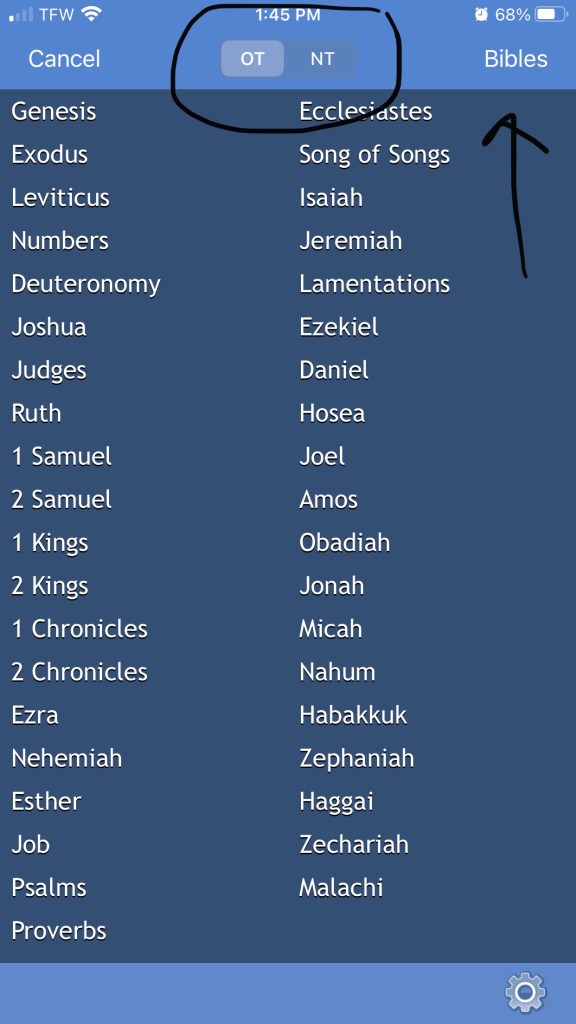
For the purposes of this blog, I’m going to the New Testament and choosing Matthew. You can see that the books are listed in order as they appear in the Bible. Click on a book to open it.

Next select the chapter you want. I’m using a verse from Chapter 4 as an example here.

Scroll down and click on the verse you want to study. I’m using verse 17.

After you click on the verse, you get the menu below. I’ll come back and talk about some other features here, but for now, we’re going to focus on studying the words of scripture in their original language, so click on “Interlinear/Concordance.”

Below, you’re looking at Matthew 4:17 in ESV. The Greek text is at the top followed by the ESV translation. I click the “Reverse Interlinear” button to put the English words on the left side of the screen. Just makes better sense to my eyes and brain.
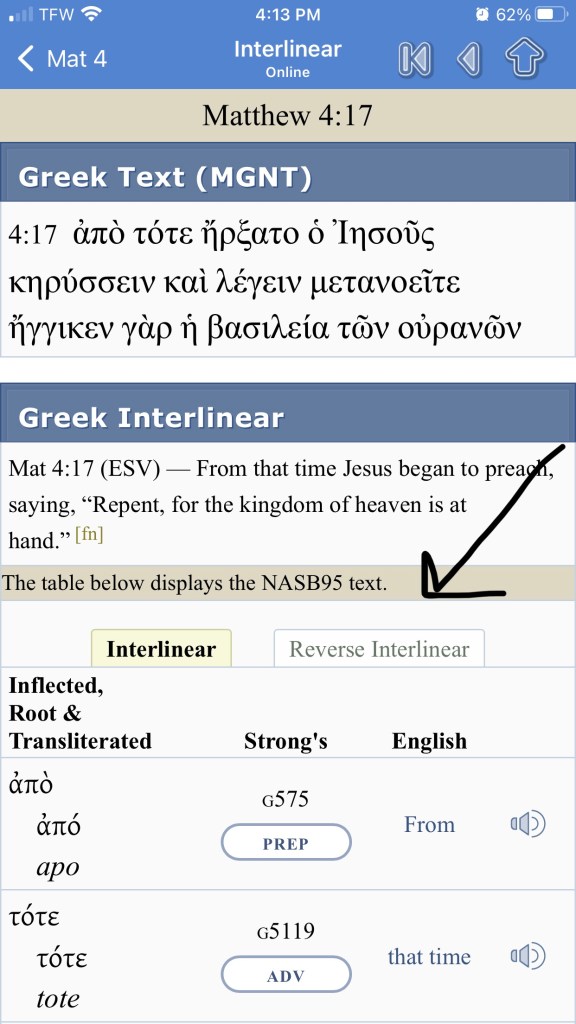
In this verse, let’s say we’re interested in the word “repent.” This is what Jesus preached once his ministry started; he began telling people to repent. So, I want to understand what he was saying. To me, “repent” means being sorry for what you did. But I want to see if there is something deeper here. It seems like an important thing if it was the message Jesus began his ministry with. So, scroll down and click on the word “repent” (somewhere near the English word itself. If you click on the oval in the middle of the screen, it’ll take you somewhere else).

On this screen, you see what the Greek word looks like and can click on the blue speaker icon to hear it pronounced. (I LOVE to do that). You can see the part of speech and any root words. (The blue words are hyperlinks you can click on to go to the entry for the root word).

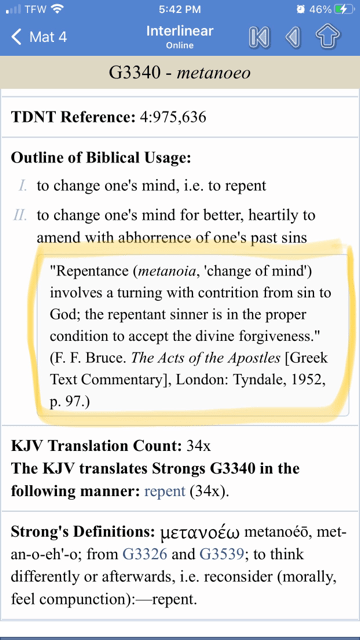
But, what I’m mostly interested in here is the “Outline of Biblical Usage” section just over half way down the screen. You can see that the definition of repent, as it is used in this verse, goes far beyond simply being sorry for what you did. And THAT is exactly why I encourage you to learn to use BLB app or some other tool to study the words in their original language. Having this understanding of how the word “repent” was used gives me richer insight into what Jesus meant in his message when he began to tell people to repent. In the highlighted section, you’ll note that repentance is when a person turns “from sin to God” {emphasis mine}. Jesus commanded that people turn away from their past sins and turn toward God. Literally, look at God rather than the sinful world. Man! That’s so rich!
Once you have a better understanding of the general definition of the word, you can go another step deeper: scroll down, and look at the Thayer’s Greek Lexicon – circled below. This portion of the Interlinear/Concordance shows you exactly how the word was used in that specific verse – rather than a simple, dictionary-type definition. So, click on the link that says “Tap to view the entire entry” to open the full lexicon for the word.

Then, scroll to the bottom of this area where you see the heading “BLB Scripture Index of Thayer’s.” (I’ve also noticed that the lexicon isn’t exhaustive – it doesn’t list all the verses in the entire Bible that use the word in this specific way). However, many of the verses are hyperlinked here. So, when you find the verse you’re looking for, click on it, and it takes you to the place in the Greek Lexicon section where it shows how the word is used in the specific verse you’re studying. The highlighted portion below shows you exactly how the word “repent” was used in Matthew 4:17.
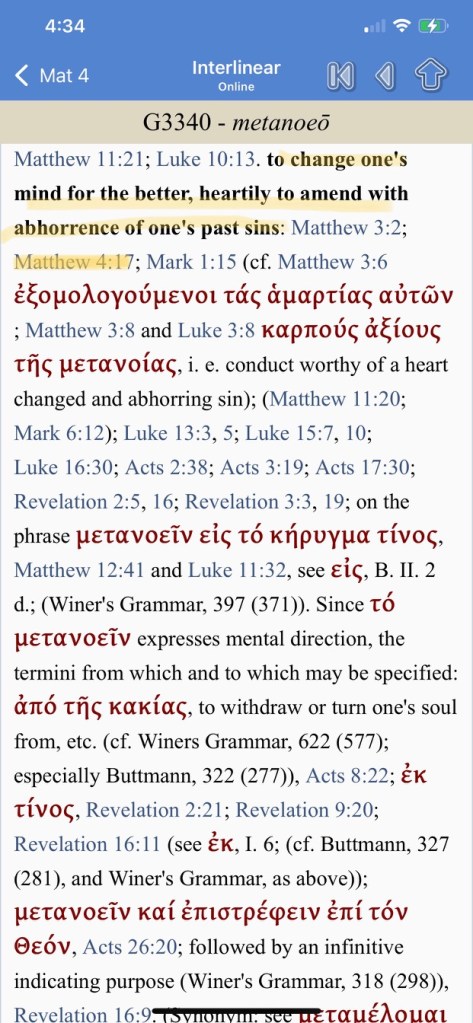
(There have been times I couldn’t find the exact verse in the lexicon. Not sure if I missed it or if it just wasn’t there. Either way, you have the basic definition(s) to go off of to get a good enough idea of what’s being said).

If you find that you love studying the Bible this way, I encourage you to try rewording the verses based on the original meanings you uncover. To do this, go through the verse, using BLB app and look up each word in the scripture or each key word or each word that was important to you. Once you had a solid understanding of the deeper meaning of the word, reword the verse using the information you found in your study. This has been a favorite activity of mine for Bible study.

*However, be sure you aren’t changing the meaning of the verse when you reword it. To be sure this doesn’t happen, pray through the word study with God, carefully look up each word, read the verse in a variety of translations, read surrounding verses to get context, and read commentary on the verse. Really dig deep into the verse before attempting to reword it. When you feel confident you understand it enough to work with it, then reword it.

*A fun hint I’ve picked up along the way is personalizing scripture. You can add your name into the scripture where a personal address might fit. Here’s an example using Matthew 4:17 – From that time Jesus began to preach, saying, “Repent, Heather, for the kingdom of heaven is at hand.” Add your name in the place of mine. You can do this with many, many verses, and it helps drive home the idea that God is speaking directly to you through His words in the Bible, and that His Word is still relevant today.

I’ve mentioned reading different versions of the Bible several times in this post, and BLB app makes it simple to do that. Without leaving the app, you can read most of the major translations of the Bible. When you’re inside the verse you’re studying, click “Bible Comparison” to switch between different translations.
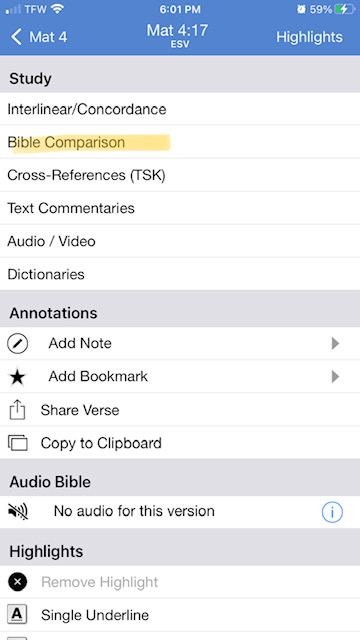
When you click “Bible Comparisons,” you start with the version you’re reading, but you can scroll down and read the verse in different translations. This has been such a helpful tool for me; I use it regularly to help me get a better understanding of the verse.

While you’re inside a specific verse, you can also click “Text Commentaries” (see highlighted below) and read commentaries on that specific verse, chapter, book, or the concept being discussed in that verse. A wealth of commentaries are loaded into the app.

I have come to enjoy David Guzik’s commentaries and will usually seek them out when I use this feature of BLB app.

Vine’s Expository Dictionary

Another app I use for studying original meanings of words in scripture is Vine’s Expository Dictionary app. It’s a more straight-forward and simpler to use than BLB. I use it when I already know the word I want to look up – I have a word in mind separate from a specific verse. (BLB is for studying specific verses then drilling down to individual words. Vine’s is for looking up the original language for a word you already know you want to study – not necessarily connected to a specific verse).

Below, the icon is circled, so you can find it in the App Store.

When you open the app, you have two choices for searching for the word – either type it in the search window at the top or click on the box with the corresponding letter of the alphabet and go from there.

I searched “righteous,” a word I often have to look up when I’m studying because I can’t get the meaning to stay in my brain 🙂 Once you find the word you want, click on it in the list.

Then, you can scroll through and read about all the varied meanings of the words in scripture. If you know a specific scripture, you can search the blue hyperlinks.

What helpful bible study hints have you picked up along the way? What tools help you most during your study time? Please share them here.

Repost – How to Study the Bible Part 1 – Just Pick It Up and Read It :-)

Do you shy away from reading the Bible because you don’t think you’ll understand what you read?

Are you worried because there are lots of weird names and hard-to-pronounce words?

Maybe you haven’t read the Bible because you don’t own one?

Maybe you don’t think you’re supposed read it because you’re not a “born-again Christian.”

Let me tell you – all you have to do to get started is pick it up and read it – or download a version to read on your phone. 😉

Image Credit: Verse of the Day

It is difficult to understand what’s going on in some places. There are lots of hard-to-pronounce names of people and places. But that doesn’t mean you shouldn’t try. It’s imperative that you read it for yourself – especially if you’re telling people you’re a Christian. You can’t rely on what other people tell you about the Bible. Even the most trusted pastor would advise you to read and study the Bible on your own, in addition to listening to sermons and messages from those trained to teach from it.

Aside from simply gaining knowledge about biblical things, reading your Bible is a way to grow closer in your relationship with God. He can and will speak to you when you spend time in the Bible.

Even if you wouldn’t classify yourself as a believer, you can read the Bible. Even if you’ve never accepted His offer of salvation, you can read the Bible. The Bible was written for you, too.

There are tools within most Bibles to help you when you’re ready to dig in and study what it has to say, and we’ll talk about some of those.

But first, here are pointers to keep in mind:

  • PRAY. Talk to God before you start to read the Bible – every time you start to read. Thank Him for giving you His written word so you can learn about who He is. Thank Him for giving you His written word so you can learn how He wants you to live. Ask Him to forgive you for your sins so you won’t be separated from Him, so that you are able to hear Him when He talks to you about what you’re reading and so you can understand things about God’s kingdom. Ask Him to open your eyes and soften your heart. Then, tell Him you will submit to His will. Ask Him to open your mind and your heart to read and understand what the Bible says. Ask Him to show you where to go and who to talk to when you need help. Ask Him to help you yield to Him when He shows you things in your life that you need to turn away from. {Hint – you aren’t going to like or agree with everything He tells you to turn from, so praying for His help to yield to His commands is important}.
  • Read and reread. It’s ok if you don’t understand what you read the first or even the fifth time. Read it again and again. Reread it even if you did understand it. Meditate on what you read – think about what it said over and over in your head. You can even use apps that will read the verses to you so you can listen to scripture.
  • Read the same thing in different translations. This is particularly easy if you have access to a smartphone or the internet. Many versions of the Bible are accessible through their own websites and there are also apps that offer different versions within the same app – you can switch back and forth by clicking on the version you want to read.
  • Ask a trusted Christian friend when you need help. Don’t have any Christians in your circle that you could go to with questions? I’m available to talk with you. Contact me through my blog, and I’ll do all I can to help.

Now, let’s look at some of the study tools available in many versions of the Bible:

  • Once you’ve prayed and God has pointed you toward the particular book to study, read the introduction to that book (if your version of the Bible offers that). I do this in my print Bibles. I have an English Standard Version (ESV) Personal Size Study Bible and a New American Standard MacArthur Study Bible (MSB). Both offer introductions at the start of each book that include information such as the author and date of the book, background and setting, key themes of the book, an outline, etc. Reading the introduction first gives you context and helps you place the information you’re about to read in the overall timeline of biblical (and sometimes broader historical) events. I do this every time I read a book for the first time.
  • Many Bible translations also offer commentary. This is extra information and insight from theologians and biblical scholars about specific verses and passages. It is important to make the distinction, however, between the scripture itself and the commentary. Scripture is the Word of God; it came from God. Commentary comes from man. It is meant to give us extra insight and help us get a better understanding of what we read, but it isn’t meant to be taken as 100% accurate like we would scripture. We must always go back to prayer and scripture for our final understanding.
The commentary in my ESV is at the bottom of each page below the scripture. Scripture font is larger than commentary font and a line separates the two in order to signify the distinction between scripture and commentary.
  • The concordance is another helpful tool found in many versions of the Bible. It’s located at the back of the Bible and is similar to an index and a glossary in reference books. Let’s say you want to study the biblical concept of “fasting”. Turn to your Bible’s concordance, find the “f’s”, and find “fast” or “fasting.” (Words are listed in alphabetical order). Now you have a list of other verses in the Bible that include the word “fast” or “fasting.” You can go to those verses and read more about biblical fasting (and the accompanying commentary for those verses). I do this when I want to focus my study on a word or concept and learn more about it from a biblical standpoint.
MSB Concordance
  • Cross-references are similar to the concordance and help us locate more scripture about a particular word or concept. Note the picture below. The arrow in the middle of the page points to a tiny “t” superscript in front of the name “Apollos” in Acts 19:1. In the left margin, another arrow points to the corresponding “t” meaning the name Apollos is mentioned again in Acts 18:24. If I want more information about Apollos, I can use this cross reference to read the scripture and any corresponding commentary about him.
Cross references are signified in the verses with superscripts (tiny letters above and to the left of the word or idea). The corresponding cross referenced verses are found in the inside-facing margin of each page.

Next week in “How to Study the Bible Part 2,” we’ll discuss studying words from the Bible in their original languages – Greek and Hebrew. You don’t have to have a seminary degree to be able to do this 🙂 Come back next week, and I’ll show you.

Watch and See

Watch and see what the Lord will do

for His children

for His beloved

for those who call on His name.

Watch and see what the Lord will do for you

in your heart

in your mind

in your life.

Watch and see how He changes lives

how He saves marriages

how He heals bodies

how He redeems souls.

Watch and see.

Watch and see how He answers prayers

when you are afraid

when you are lonely

when you seek Him.

Watch and see what He does

when you submit your life to Him

when you return to Him

when you confess your sins to Him.

Watch and see.

I know what He’s done for me

in my heart

in my mind

in my life.

I have seen His mighty power

to change hearts

to redeem lives

and to answer prayers.

Does Looking at Corn Make You Wanna Praise the Lord?

More than likely your answer to the question in the title is “no,” and that’s perfectly ok. But I’m a nature geek, so I’ve always felt a sense of awe at the natural world and marveled at the way God created it and all the amazing plants and creatures in it. For me, it’s fascinating to learn how the natural world works.

Last year, we planted a garden at our house for the first time. (I worked in the garden at my grandma’s house in the summers when I was younger but hadn’t had one of my own until last summer). We had success with our tomatoes, okra, jalapenos, and bell peppers but failed to get much yield out of our corn, cucumbers, watermelons, and cantaloupes.

I noticed the same thing happening this year with the corn. It popped up quickly once planted, eventually tasseling out at the top, and then showing silks on individual ears.

My mom and grandma taught me that when the silks on the ears of corn turned dark brown, the ears were ready to be picked. So last year, I was excited when I saw the first dark brown silks.

But when I grabbed the first ear with dark brown silks, I knew immediately that it wasn’t ready. The ear was too skinny. The kernels hadn’t filled out.

This year, when the first shiny white silks emerged, I decided to figure out what went wrong and try to fix it.

Research suggested that the ears didn’t fill out because they didn’t pollinate.

Here’s where the cool part comes in (fellow nature geeks get ready to get excited): the things that pop out of the top of the corn stalk – the tassels – hold the plant’s seeds. Those seeds contain the pollen grains needed to pollinate the ear of corn by coming in contact with the silks on each ear. The idea is that, when the wind blows, the pollen grains fall off the tassel and land on the silks. I learned that, if the corn isn’t pollinating, I can take some of the pollen grains off the tassels and put them on the silks.

(Whole stalk of corn) (Tassels at the top) (Pollen grains on the tassel)

As I was doing that one morning, I happened to look at the whole plant and noticed that many of the long, downward-curved leaves already had pollen grains on them and some of those grains had slid down the leaf to gather in a heap at the stalk (where the ears of corn attach).

BOOM! It hit me! It was because of the way God designed the leaves! Because of their shape, the leaves act as funnels. They’re broad and flat so they catch the grains when they fall. The leaf is also slightly concave and curved downward toward the stalk, so the grains that hit the leaves are funneled back toward the growing ears of corn and their silks. The natural shape of the leaf is the reason the plant can pollinate itself!!!

(Downward-curved,broad, flat leaves) (Pollen grains funneled toward the stalk)

Wow! Go God! You are so amazing!

When I “put two and two together” as they say, I was blown away! The Creator of the whole universe designed this humble little plant in this simple but effective (and brilliant!) way for a specific reason. He gave the leaves a job to do and fashioned them in such a way that they could do the job. Even better, the leaves are still doing the job He created them to do!

That gave me goose bumps! I had a little worship moment right there in my backyard garden.

And that’s how it should be. God’s creation should cause us to rejoice. Noticing the natural world and all its wonders should point us to our Creator in heaven. We should delight in the God who fashioned our world, who wonderfully provides for His creation, who takes pleasure in what He made, and who continues to provide for it and care for it!

When we wonder at nature, we wonder at God. When we wonder at God, we worship Him. When we worship God and our hearts and minds focus on Him, anxiety lessens, stress releases, gratitude and thanks increase, and our hearts and minds learn to love and trust Him. (And trust me, we all need a little more of that)!

Isn’t that why He made the world – to display His glory? The natural world points to its Creator and inspires awe and worship.

And I realized – looking at a stalk of corn – the tassels, the leaves, the silks, the ear – the God of the universe who imagined and designed and created this plant to do what it does also created you and me. If He continues to care for this plant, still taking pleasure in seeing it fulfill its purpose, still providing what it needs to grow, won’t He do even more for His children who were made in His image?

I say, “Bless the LORD, O my soul! Oh LORD my God, you are very great!” Psalm 104:1 (ESV)

I say, “O LORD, how manifold are your works! In wisdom have you made them all: the earth is full of your creatures.” Psalm 104:24 (ESV)

And I say, you created the whole world, Lord. You can be trusted with my life.

Amen!