Wait…I Have to Love My Enemies?

Has this ever happened to you: Someone hurt your feelings? Talked about you behind your back? Someone was difficult to deal with? Made your life hard or unpleasant?

Of course. We’ve all experienced hurtful situations and challenging people. We may not think of these people literally as our enemies. I definitely don’t think of myself as having enemies. That word’s a little harsh. But we certainly don’t think fondly of people who have wronged us. I know I have people in my life who are difficult to love. They rub me the wrong way. Our personalities don’t mesh well.

However, Jesus was clear that believers must love our neighbor – anybody we come into contact with during the course of our day – and we must love our enemy – the people who have hurt us.

Lately, I’ve been interested in exactly HOW to love others. Does the Bible give me specific instructions on exactly what to do to show love to my neighbor and my enemy?

To find out, I went back to the verse that started this whole thing: Ephesians 5:2, “And walk in love, as Christ loved us and gave himself up for us, a fragrant offering and sacrifice to God (ESV).” And I studied the two Greek words for love used in the verse – agape and agapao. Agape is a noun: a thing, concept, or an idea. Agapao is a verb: something you do, an action.

Using the Blue Letter Bible app, I read through all the verses that used agapao and noted verses that gave explicit directions – something specific to do to show love. The first concrete instructions in the New Testament using the verb agapao were given by Jesus. In Matthew 5:44, he said, “But, I say to you, Love your enemies and pray for those who persecute you (ESV – emphasis added).”

How do we love others? How do we love people who have done us wrong? Pray for them – all of them – the ones who wronged us, treated us poorly, talked about us behind our backs, don’t deserve our kindness…

Jesus told us to have a conversation with God about that person; that’s what prayer is anyway, a conversation with God.

Can you ask God to burn the bread they’re toasting for breakfast or to give that person a flat tire on the way to work?

NO 🙂

But, you can ask God to change him or her…to make that person into someone who acts kindly, stops spreading rumors, leaves your child along at school. All those requests are fine. In our conversations with God, we’re allowed to tell Him our hearts’ desire.

However, Scripture specifically instructs us to pray for our enemies’ salvation, to express thankfulness for those people, and to pray for their well-being (1 Peter 3:9).

Image Credit: PinImg.com

Sounds extremely difficult, right? When you’re upset with someone, the last thing you want to do is to pray for that person’s well-being! No! You want to call your best friend and tell him or her about who wronged you and how angry you are.

But, this has no place in the life of a Christ-follower. Jesus said we were to love the people who persecuted us. He also said, “do good to those who hate you (Luke 6:27 ESV).”

The apostle Peter echoed this when he wrote, “Do not repay evil for evil or reviling for reviling, but on the contrary, bless, for to this you were called that you may obtain a blessing (1 Peter 3:9 ESV).”

Do good to people who hate you? Bless people who have done evil to! Can you imagine?

The Greek word used for bless means “speak well of,” and this is what God calls us to do. Don’t repay gossip with gossip or cruel words with cruel words.

Instead, try to say something pleasant to or about that person. Or, maybe try what my grandmother and mother taught me: If you can’t say something nice, don’t say anything at all.

Do you know what might happen in prayer with God when you talk to him about this person who is difficult to love? He might have some things to say to you as well. A conversation goes two ways, right? He may convict your heart to pray for that person’s soul and salvation. He may encourage you to overlook the offensive things that person has done and will do. He may command you to forgive. To continue to be kind no matter how you’re treated. To speak well of that person (or at least to keep your mouth shut).

So, in your prayer time with God, specifically about this difficult person, who is God actually changing?

You.

Crazy how that works, isn’t it.

I’m not saying the other person won’t also change as a result of your prayers. That is a likely outcome as well. But, God will definitely change you during your time in prayer with him.

Try it.

Right now, think of a person in your life who is difficult to deal with. Someone who has said something to you or about you or done somehting to you and upset you.

Stop right now and pray for that person. Ask God to speak to that person’s heart. Ask God to pursue that person for an intimate relationship like He (hopefully) has with you. Pray for that person’s soul and salvation. Pray for that person’s family. Job. Health.

Ask God to tell you other ways you could show kindness and love for that person and ask Him to give you the strength to do it.

Give God a chance to show you what He can do.

Image Credit: The Romantic Vineyard

Maybe this sounds unrealistic or oversimplified. And honestly, you won’t see the outcome you want from each “enemy” you pray for. But that doesn’t matter. It’s what Jesus taught, so it is what God expects. As His children, we should respond with obedience, no matter the outcome.

Everything I Needed to Know I Learned from my Grandma

“The best thing you can do to someone who is being mean to you is to be as nice as you can to them.” I distinctly remember sitting on a stool at the counter in my grandma’s kitchen one afternoon after school when she said this to me.

Seventh grade was my first real encounter with girls being mean just for spite – saying snide things about my clothes or my hair or something like that. Undoubtedly, she and I were talking about this, and her advice was to be as kind as I could in return.

That sounds crazy, right?! It definitely isn’t worldly advice. Worldly wisdom says to be mean back to those girls. The world’s advice is to get even when someone does you wrong. But, grandma was saying to be nice!

She said, “being nice in return is your best choice because it is the opposite of what the person expects. That person expects you to cry, but you don’t cry, at least you don’t cry in front of her. If you’re nice, she doesn’t get the reaction she was looking for. There’s no drama. And a lot of the time, that person will eventually move on. It’s a really good way to handle a bully. And,” she added, “it’s what the Bible says to do, too.”

At some point in the conversation, I’m pretty sure I remember the phrase “heaping burning coals on their head.”  Grandma said that was the part from the Bible… So, if the Bible and Grandma said it, it was good enough for 13-year-old me.

In my lifetime, I have come to find that Grandma was right. The best thing to do is to be kind to people even when they aren’t kind to you. She was also right when she said that most of the time, your response would make them leave you alone…eventually.

But where did Grandma get this? She told me it was biblical?

As an adult who is concerned with living a godly life, I’ve looked into this further and found that it is indeed advice from the Bible. King Solomon, in all his God-given wisdom, wrote about it in Proverbs, and Paul echoed it in his letter to the Romans.

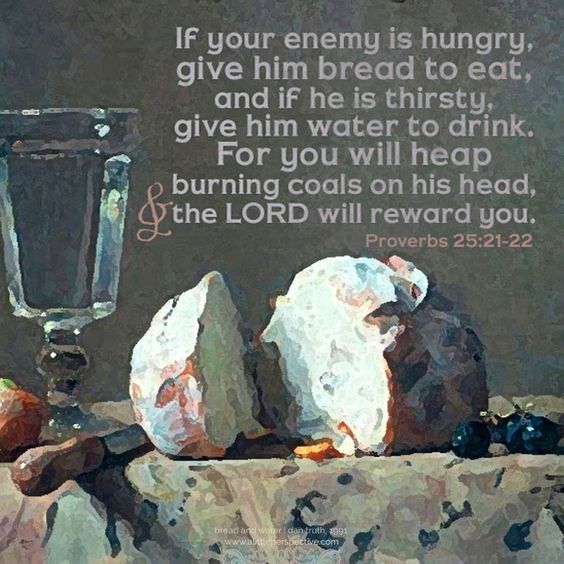
Proverbs 25:21-22 says, “if your enemy is hungry, give him bread to eat, and if he is thirsty, give him water to drink, for you will heap burning coals on his head and the Lord will reward you. “

Um…what?

The English Standard Version Study Bible (ESV) explains these verses the best:

The image of the burning coals on your enemy’s head is “likely an image for leading him to repentance or shame, suggesting that he will feel inward burning pangs of guilt for his wrongdoing. In any case, the message is clearly to repay evil with good… The image of ‘burning coals’ does not imply something that harms the enemy because it further explains the bread and drink in Proverbs 25:21, which do him good, and also because Proverbs forbids taking personal vengeance… Finally, ‘the Lord will reward you’ implies a good result from ‘burning coals’ which is most consistent with leading a person to repentance.”

To understand how this works, jump ahead to Romans 12.  Verses 9-21 discuss Christian behavior and echo things many of us are used to hearing:

“Bless those who persecute you; bless and do not curse them” (verse 14)

“Live in harmony with one another” (verse 16)

“Repay no one evil for evil but give thought to do what is honorable in the sight of all” (verse 17)

“If possible, so far as it depends on you, live peacefully with all” (verse 18)

Romans12_18.jpg

Photo Credit: Pinterest

“Beloved, never avenge yourselves, but leave it to the wrath of God” (verse 19)

Then, we get to verses 20 and 21:

“… if your enemy is hungry, feed him, if he’s thirsty, give him something to drink; for by doing so you will heap burning coals on his head. Do not overcome evil by evil, but overcome evil with good.”

Romans-12-21.jpg

Photo Credit: sermonquotes.com

“There are those burning coals again,” you might think. “Heather, are you sure this is what it means to be nice to someone who has wronged me? Sounds like you’re just being mean right back. “

Well, in Romans 12:20 (above), Paul quotes Proverbs 25:21-22, but, you have to go back to Romans 12:9, earlier in the same section, to get some context and to properly seat the instructions of Romans 12:20 in the right frame for the Christian. Verse 9 says, “let love be genuine. Abhor what is evil and hold fast to what is good.”

Clingtowhatisgood.jpg

Photo Credit:Pinterest

That explains the whole thing.

Being nice to someone who is mean to you isn’t some weird way to get revenge.  The important thing to ask yourself is, “how do I feel about this person in my heart when I am nice to her in return?” Literally, what is the condition of your heart? What is your motive?

The point – and this is the hard part, this is where prayer comes in – is that your love for that person has to be genuine. Verses 9-21 of Romans 12 are, according to the ESV, a “description of the life that is pleasing to God.”  And the section starts off with love.

When we are genuinely kind to the person who wronged us, our motivation is love. We don’t heap coals to hurt that person; we heap coals to help that person.

When we repay evil with good, we do so in hopes that our behavior will soften the heart of the wrongdoer. Our purpose is always to point people back to God, to show people His love.

The strangeness she feels when you repay her evil with good should start something in her heart. It should cause her to stop and question: “How can she be nice to me after how I spoke to her?”

God can use that to change a person’s hearts; all He needs is a little soft spot to take hold of.

Above all, we are called to love, genuinely.

This takes a lot of prayer… Prayer for God to show us how to live. Prayer for God to change our hearts. Prayer for God to show us how to love people like He loves them.  Prayer for God to help us love the unlovable.

This is how we live the life of a believer the way that God wants us to live. And it’s what Grandma was talking about all those years ago that afternoon in her kitchen.


Great90.jpg

Grandma last year on her 90th birthday with Ethan and Emery.  We celebrated her 91st just a few weeks ago 🙂