More than likely your answer to the question in the title is “no,” and that’s perfectly ok. But I’m a nature geek, so I’ve always felt a sense of awe at the natural world and marveled at the way God created it and all the amazing plants and creatures in it. For me, it’s fascinating to learn how the natural world works.
Last year, we planted a garden at our house for the first time. (I worked in the garden at my grandma’s house in the summers when I was younger but hadn’t had one of my own until last summer). We had success with our tomatoes, okra, jalapenos, and bell peppers but failed to get much yield out of our corn, cucumbers, watermelons, and cantaloupes.
I noticed the same thing happening this year with the corn. It popped up quickly once planted, eventually tasseling out at the top, and then showing silks on individual ears.
My mom and grandma taught me that when the silks on the ears of corn turned dark brown, the ears were ready to be picked. So last year, I was excited when I saw the first dark brown silks.
But when I grabbed the first ear with dark brown silks, I knew immediately that it wasn’t ready. The ear was too skinny. The kernels hadn’t filled out.
This year, when the first shiny white silks emerged, I decided to figure out what went wrong and try to fix it.
Research suggested that the ears didn’t fill out because they didn’t pollinate.
Here’s where the cool part comes in (fellow nature geeks get ready to get excited): the things that pop out of the top of the corn stalk – the tassels – hold the plant’s seeds. Those seeds contain the pollen grains needed to pollinate the ear of corn by coming in contact with the silks on each ear. The idea is that, when the wind blows, the pollen grains fall off the tassel and land on the silks. I learned that, if the corn isn’t pollinating, I can take some of the pollen grains off the tassels and put them on the silks.


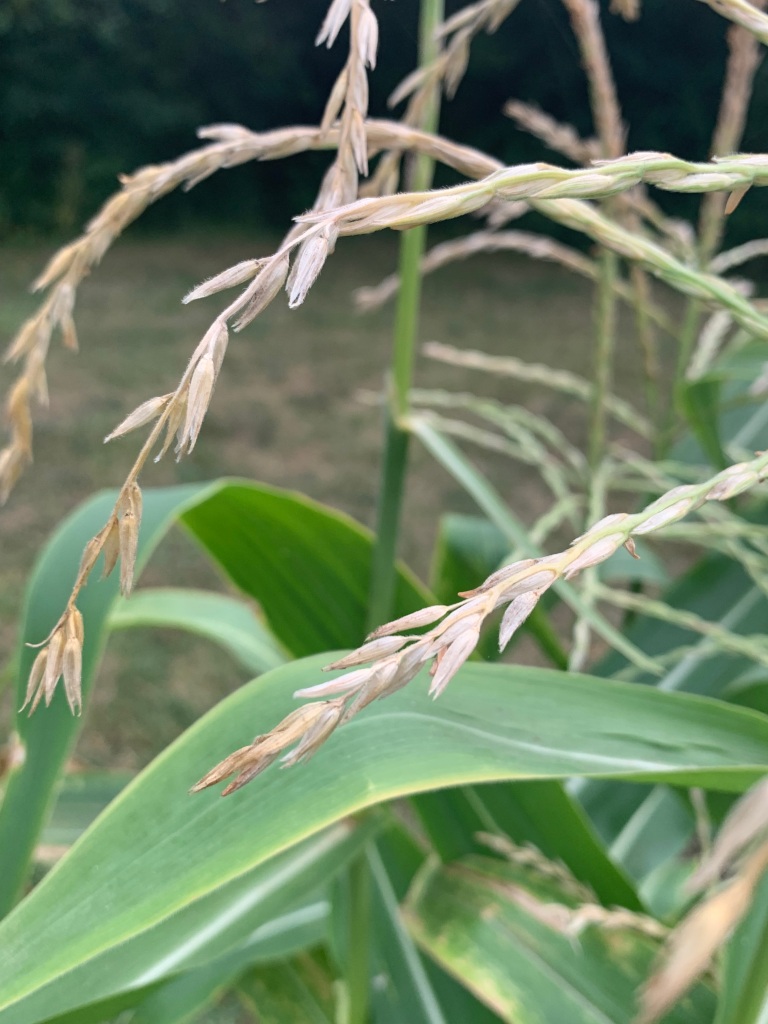
(Whole stalk of corn) (Tassels at the top) (Pollen grains on the tassel)
As I was doing that one morning, I happened to look at the whole plant and noticed that many of the long, downward-curved leaves already had pollen grains on them and some of those grains had slid down the leaf to gather in a heap at the stalk (where the ears of corn attach).
BOOM! It hit me! It was because of the way God designed the leaves! Because of their shape, the leaves act as funnels. They’re broad and flat so they catch the grains when they fall. The leaf is also slightly concave and curved downward toward the stalk, so the grains that hit the leaves are funneled back toward the growing ears of corn and their silks. The natural shape of the leaf is the reason the plant can pollinate itself!!!


(Downward-curved,broad, flat leaves) (Pollen grains funneled toward the stalk)
Wow! Go God! You are so amazing!
When I “put two and two together” as they say, I was blown away! The Creator of the whole universe designed this humble little plant in this simple but effective (and brilliant!) way for a specific reason. He gave the leaves a job to do and fashioned them in such a way that they could do the job. Even better, the leaves are still doing the job He created them to do!
That gave me goose bumps! I had a little worship moment right there in my backyard garden.
And that’s how it should be. God’s creation should cause us to rejoice. Noticing the natural world and all its wonders should point us to our Creator in heaven. We should delight in the God who fashioned our world, who wonderfully provides for His creation, who takes pleasure in what He made, and who continues to provide for it and care for it!
When we wonder at nature, we wonder at God. When we wonder at God, we worship Him. When we worship God and our hearts and minds focus on Him, anxiety lessens, stress releases, gratitude and thanks increase, and our hearts and minds learn to love and trust Him. (And trust me, we all need a little more of that)!
Isn’t that why He made the world – to display His glory? The natural world points to its Creator and inspires awe and worship.
And I realized – looking at a stalk of corn – the tassels, the leaves, the silks, the ear – the God of the universe who imagined and designed and created this plant to do what it does also created you and me. If He continues to care for this plant, still taking pleasure in seeing it fulfill its purpose, still providing what it needs to grow, won’t He do even more for His children who were made in His image?
I say, “Bless the LORD, O my soul! Oh LORD my God, you are very great!” Psalm 104:1 (ESV)
I say, “O LORD, how manifold are your works! In wisdom have you made them all: the earth is full of your creatures.” Psalm 104:24 (ESV)
And I say, you created the whole world, Lord. You can be trusted with my life.
Amen!
 Servant Girl Stories
Hello Heather,
<
div>I’m so happy th
LikeLike