Fixing Me Was God’s Job (Repost)

Author’s Note: Ethan and Emery are in school, and i am on week 2 of my new job (will blog about that soon since I addressed it in an earlier post). So, I am taking a short break from writing new posts this month so I can focus on time with the kids and getting used to the new job.  In the meantime, I am reposting pieces of my testimony that were published when I started the blog in October 2017). 

God can use any time, place, or circumstance He wants to use to get through to you.  He can speak to you in the most unlikely of places and in the craziest of ways.

When I was 31, after spending more than 10 years ignoring God’s voice (and at times even denying that Jesus existed), I actually obeyed God’s calling and left my full-time job to be a work-from-home-mom and be with my then-16-month-old son.

To date, it it probably the craziest thing I have ever done.  Most of the things God asks us to do seem crazy at the time; that’s why those things are known as a “leap of faith.”  They aren’t things we could accomplish in our own power or with our own knowledge, skills, or money.

And that’s where I was in May 2010: being obedient to Jesus when I still wasn’t even sure I believed in Him!  I didn’t have trouble believing in a Creator God overall, but I had lost Jesus – the man who walked and talked and healed and taught and died and lived again.

So, what God did was to remove me from the busyness of the life I had created with a job and a mortgage and a husband and a child and a pet, and He sat me down at the family-heirloom dining table in our house and confronted me with myself.

Now, I’m not trying to say that staying home with your baby isn’t busy, but it was a lot less so for me than when I worked full-time outside the home.  I still worked part-time from home and cared for our home and our son, but God had cleared my schedule quite a bit.

Life was quieter now.  Life was slower now.  I had time to think.  (Funny, “thinking” was what got me into the mess I was in in the first place, but thinking was also what God used to get me out).  I finally acknowledged that I needed help with my mind and my thoughts about God and Jesus.

At first, I tried to fix myself.

I remember reading a book or two I thought would help me believe in Jesus again.  At this point, I really wanted to believe in Him but couldn’t fathom ever being able to again.

I did pray sometimes and ask God to help me.

I was so used to scholarly-type study from 6 years of higher education that I thought maybe I could study my way back to believing in Jesus.

So, I got a Bible commentary to read what scholars said about the Bible hoping that some smart person’s “proof” would sway me.  I read the book of James because I heard someone say it was a good idea for new Christians to start with that book when reading the Bible.

God led me to meet some Christian moms from our church and start going to MOPS – Mothers of PreSchoolers – at our church with them in the fall of 2011.

I began to feel God more.  It was slow, but it was there.  I knew my worldview was made-up, but I still didn’t want to submit it to God.

I was working hard to fix myself before I went back to the Lord.  I thought He wanted me fixed before He would take me back.  {Spoiler alert} That’s where I was wrong.

Fixing me was God’s job.  Fixing YOU is God’s job.

He doesn’t require us to come to Him already perfect.  {Hint} If you wait until you’re perfect before you go to God, you’ll never go to Him.  If God waited to save us until we were perfect, He’d never have anyone to save!

Portrait of a Servant Girl – Carol’s Story – Part 4

This week’s post is the conclusion of Carol’s story in the Portrait of a Servant Girl series.

“As I was reeling from the separation and divorce from my husband, I was also caring for my father who was suffering from dementia,” Carol said, continuing with her story. I sat in the upstairs office at her home along with her and my sister Tiffany who has been friends with Carol for 18 years.

The harsh irony of this part of Carol’s story was palpable. I certainly didn’t expect her to tell me that she’d cared for the man who was controlling and abusive to her, her mother, and her siblings.

I must have looked surprised because she went on. “Yes, after my mother died, I inherited my father. He couldn’t live alone, so I brought him home with me. Within a couple of months, his dementia became so bad that we had to put him in a memory care center.”

Carol talked about visiting him daily, early in the morning, when he was at his best. “He had ‘Sundowners Syndrome,’”she explained, “so he was more lucid and pleasant earlier in the day and confused and agitated in the evenings.“

This was yet another painful experience that involved her father. But, as she talked about those months, she actually smiled. “At the time, taking care of my father was very painful, but now those memories bring laughter. Daddy was always trying to get to the coal mine,” she said. “Most days I found him sitting by the door waiting for his ride to work. I would try to redirect his thoughts and tell him it was his day off.”

She stopped and smiled to herself, and I realized she called him ‘daddy’. Throughout the interview, she referred to him as ‘father’ but, in reliving the memories of caring for him during his illness, and recalling the humorous times, she called him ‘daddy’.

“He was always looking for his keys,” she continued, shaking her head but smiling a little. “And one morning we worked and worked for a long time trying to jump-start his wheelchair!”

She paused. Her eyes were far away, but she wore a pleasant expression, one of nostalgia and happiness.

“That day was the best!” She laughed.

She looked at me, and her thoughts came back to the room. To the present day and our interview.

“I had the opportunity to read the Bible to him,” she said, satisfaction in her voice. “We talked about his relationship with Jesus.”

Carol shared that the week before he died, he saw angels.

“I had to write his eulogy,” she told me. “The morning after he died, I got up, and the words just flowed from my pen. I wrote about how he had to raise himself, never had a father, lived in a boarding house, and went to work in the coal mine when he was 13.” Her voice was clear and strong as she described this. Her face was calm and resolute. “When I was writing the eulogy, God showed me that my father had learned to survive by controlling at a very young age. I realized that he did the best he could with what he had.”

Carol’s voice was calm and peaceful. I was amazed to see her reliving all those painful memories – abuse from her father, cancer, divorce, caring for her father in his old age and sickness – with… was it joy? Joy because of how those trials deepened and strengthened her relationship with God? Joy because of the redemption she experienced both for herself and for other broken relationships in her life?

“I thank God for the time I had with my father before he died,” she said after she had been quiet for a while. “ I thank Him for revealing all this to me and for helping me to love and to forgive my father. I have peace about that now.”

What a beautiful story of love, mercy, and grace! And isn’t this what God has done for us? We neglect Him. We abuse Him. We want Him to do things our way. Yet He patiently waits. He cares for us when we need Him. He redeems us when we come to our senses and allow Him to take His rightful place in our hearts. And, most amazing of all, He loves us the whole time.

Carol’s marriage ended in July 2001, and her father died in September 2001. For the next few years, she rarely went anywhere other than to church.

“Finally, my sister and my daughter told me I needed to get a life. They asked, ‘what do you want to do?’ Well, I always wanted to take Shag dance lessons,” she shrugged, “so I decided to do that.”

Carol signed up for lessons and showed up for class on the first day. She didn’t know one other soul in the room. However, a sweet lady saw her come in by herself and asked Carol to sit at her table.

“We talked a little while, and then she said, ‘I have a friend you just have to meet!’”

The lady told Carol about a man named Ed Jones, a widower who lost his wife to ALS.

“She talked about him for a while, and I said I would be willing to speak with him on the phone,” Carol explained. “He called me, and we spoke for a while, and I invited him to a party I was having at my house the next month, December 2003. He came to the party, and we had a nice time talking. He even stayed to help me clean up. Several busy months passed, and we connected again in February 2004 and were married that May.”
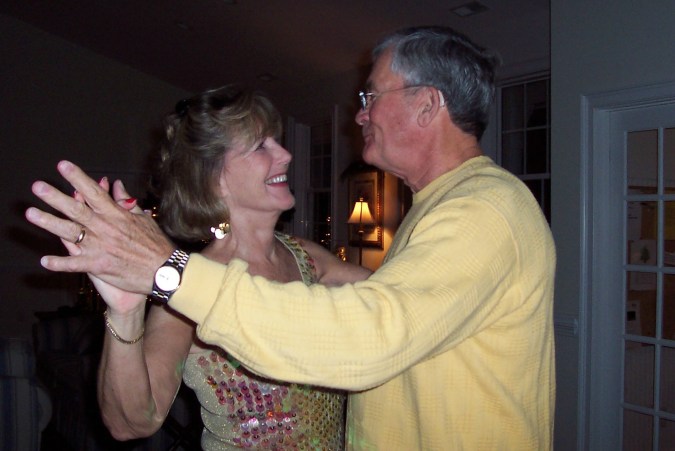
100_2192.JPG

Carol and Ed Jones

When Carol married Ed, she inherited a wonderful family: his children and grandchildren including his youngest granddaughter who was a toddler at the time. Carol was thrilled to have a grandchild who lived close.

“I got to see her every week,” Carol beamed.

We spoke a little about Ed’s family, and then, as if on cue, we heard a deeper voice from downstairs say, “Do I need to pull out the guest bed up there?”

Tiffany laughed, “That is Mr. Ed’s way of saying it’s time to go!”

I looked at my phone. It was after 10 PM. We had been talking for over two hours!

We spoke for another minute or two about some of Carol’s work in the church: she’s been on a mission trip to Guyana to help build a youth center. She’s planned church fundraisers and other ministry events. She serves in the kitchen in the summer youth camp. She’s been a delegate for her church at the annual conference. She volunteers in the church office.

“I’ve also been on an outstanding trip to the Holy Land and participated in the Methodist Church’s Emmaus walk. I experienced an enormous spiritual growth on Emmaus,” she explained.

I knew it was very late and that Tiffany and I need to go, but I wanted to wrap up with one final question.

“What would you like people to know about Jesus?” I asked her.

She listed many important things about Him that she’s learned in her life.

“He will never leave you or forsake you,” she began. “You can always trust Him. He will give you peace, and joy, and be the best friend you could ever want. You have to pray and study the Bible to grow this relationship though. It doesn’t happen on its own.”

As we were standing to leave, she said, “I’m not saying there won’t be any more valleys in my life, but I have the assurance that God will go through them with me.”

I know that she recently experienced another valley this past spring when she had hip replacement surgery.

“I also know that the Bible tells us that when we are weakest, He is strongest. I have certainly found that His strength is enough for me.“

ec9d1d6804ab781864c9fa52093d8753.jpg

Photo Credit: Pinimg.com

Portrait of a Servant Girl – Carol’s Story – Part 3

This week’s post is a continuation of Carol’s story in the Portrait of a Servant Girl series.

“I didn’t question God about the cancer,” Carol repeated at another point during our interview.  “But there was a time, years later, that I got very angry with Him. I remember being on my knees crying out to Him, ‘Is this what I get for being good?  I’ve lived my life for you!’” She stopped for a moment and took a deep breath.

“I was so broken,” she continued.  “I asked God, ‘Why would you do this to me?  You just don’t know how broken and rejected I feel!’”

She stopped again, and I could see her shoulders relax.  “After I said that to Him,” she went on, “there was a calm that came over me, and I got quiet.  I felt Him put His hand on my shoulder, and He reminded me of what He went through. He said to me, ‘I understand.  I was rejected, too.’”

There was another pause.

“After that, I still suffered from the rejection, but I did not complain,” she finished, matter-of-factly.

Thirty years prior to this encounter with God, in the mid 70’s, Carol had survived Stage IV colon cancer that metastasized to her lymph nodes.  Now, her world was falling apart again. Her husband of 33 years no longer wanted to be married to her.

“This certainly wasn’t the life I planned,” Carol said earnestly.  “My future looked hopeless. But then I had the encounter with God when He reminded me that He’d been kicked and spat on.  That only one of His disciples stayed with Him until the end. From that day on, my healing began.”

Carol commented that the divorce was worse than cancer.  When I asked her why, she explained that she had control of how she handled cancer, but she couldn’t control the rejection by her husband. That was something she never thought would happen.

“Like the cancer, the divorce brought me even closer to God.”  She explained. “He used the circumstances to grow my faith in Him.”

05d2c8cdb39ba3607276b88cf94c2d7e.jpg

Photo Credits: #GODisHOPE

If you’ve never experienced God’s provision during a storm in your life, this probably sounds insane – that you can grow closer to God during adversity.  Of course, it can go the other way easily. You can get angry at God because He’s allowed the storm, and you pull away from Him.

Or, you could turn towards Him, even run to Him, and fall into His arms like Carol did.

“When I was going through my divorce and long afterwards as I continued to suffer, I received encouragement from reading the Bible.  Many, many times God spoke to me through His Word and provided wisdom or the answer I needed in a particular situation,” Carol told me.

“Could you give me an example of something specific God said to you through His word that helped you in some way?” I asked.

She thought a moment, then said, “when someone hurts you, human nature is to hurt that person back.  We think revenge will make us feel better. But, God reminded me many times that it wasn’t up to me to exact revenge.  Romans 12:19 assures us that revenge is God’s task.”

il_570xN.1538719101_e5nl.jpg

Lila Prints Etsy Shop

“What else did you learn?”

“Well, God taught me that a living prayer relationship with Him comes when we dare to level with Him.  When we dare to be honest with Him about how we feel…like when I complained to Him that He didn’t understand my brokenness and rejection.  When I got honest, He spoke clearly to me. I wasn’t making small talk anymore. I wasn’t pretending that my life was perfect anymore. I was on my knees with tears streaming down my face.  He came in and comforted me. This moved my relationship with God to a much deeper level.”

God also used Carol and her story to reach other people.  After the divorce, the Associate Pastor at Carol’s church in Wilmington, North Carolina approached her about sharing the adversity in her life with the church.

“She said, ‘People look at you and think you have no cares in the world,’ and she asked me to share my testimony as part of a worship service.”  Carol paused, and a smile tugged at the corners of her mouth.

“I was never one to speak in front of others.  I liked to organize and work behind the scenes,” she explained.  “I really didn’t want to do what she asked me to do.”

“What made you change your mind?”  I asked.

“I had so much faith and trust in the pastor who asked me.  I knew the Holy Spirit worked in her, and I knew that whatever she asked was from God.  I just couldn’t say no.”

Services at Carol’s church were televised, so after she spoke, the church began receiving requests for her to speak at other events.  This led to years of travel around the southeastern United States sharing her story at women’s events.

“When you are sharing your story, and God allows you to see that other people receive help from it, you’re healed as well.  This is another way God supported me during this time.”

Carol stopped for a moment then continued, “plus I was driving a lot, so there was lots of time to pray, and talk to God, and listen.”

Then, she shrugged and added, “What good would the bad things be if you didn’t share them with others so you could help them, too?”

Please join me next week for the conclusion of Carol’s story.

To receive emails each week when I publish posts, please subscribe to Servant Girl Stories (in the right sidebar). 

Portrait of a Servant Girl – Carol’s Story Part 2

This week’s post is a continuation of last week’s post, Portrait of a Servant Girl – Carol’s Story Part 1 in the Portrait of a Servant Girl series.

At age 19, Carol felt stuck. She had lived for years with a controlling, abusive, alcoholic father. She was fearful, ashamed, and desperate to get out.

She saw marriage as her escape route.

“I got married for all the wrong reasons, and that marriage didn’t last long,” she said, simply.

After the divorce, she and her daughter, Beverly, moved on together.

Carol & Bev Gandee_0001.jpg

Beverly and Carol

“Then, I married the man of my dreams who was kind, charismatic, a businessman, and he never argued,”  she explained.

They were married, became a family of 3, and began what was, in many ways, the kind of life Carol always wanted.

It seemed that she’d achieved the perfection she’d never been able to grasp as a child in her father’s home.  She was in control. She was directing her life. Things were going the way she wanted them to go.

However, when Carol was 32, all that crumbled.  She’d been sick for about 5 months, going to their family doctor and complaining of weight loss and pain.  Again and again, the doctor told her she was probably just doing too much. He found nothing else wrong.

Finally, one day Carol left work and went to the emergency room pleading for help from the pain. Thinking the problem might be an ovarian cyst, the doctor decided exploratory surgery was the route to take.  During the procedure, he discovered a tumor that he knew to be cancerous based on its location.

After the procedure, the doctor told Carol that his first instinct was to close her up and take no further action.  You see, there have been many advancements in what doctors know about cancer and how they treat it since Carol’s surgery 44 years ago.  For example, it was widely held that exposing cancer to the air would cause it to grow and spread quickly, so he thought twice about taking that chance.

However, he decided to remove the tumor and part of the colon hoping to give Carol relief from the pain.

Tests revealed Stage IV cancer that had metastasized to the lymph nodes. After 21 days in the hospital, Carol was sent home and told to “get her affairs in order”.

“The first Sunday after returning home from the hospital, Beverly, Kent, and I were at church and went to the altar to pray.  The congregation was singing the hymn ‘He Touched Me,’ and I just totally surrendered to the Lord,” she said throwing up her hands.

“What did you surrender?”  I asked.

Carol gave a small laugh and dropped her eyes.  Then, she looked back at me and grinned sheepishly.  “I had a reputation for being a drill sergeant. I gave orders.  I was organized, and I controlled things,” she explained.

“You see,” she continued.  “At age 12, I gave Jesus the keys to the door of my heart, but I kept a lot of other rooms locked because I wanted to control the course and direction of my life.  Once I had the experience with cancer, Jesus became the Lord of my life. Before He was my Savior, but after that, I totally surrendered my life, and that brought me tremendous peace.”

“Were you angry at God because you had cancer?”  I asked her.

“I don’t remember questioning God about why,” she said.

“Were you afraid to die?”

“My prayer was to live long enough to take care of my young daughter,” she answered.  Beverly was in 5th grade when Carol was diagnosed.

That’s when God began to show what He’d been doing in the background the whole time.

Carol’s sister-in-law, Nancy, a nurse anesthetist, met Genevieve, another nurse, at a conference.  After hearing about Carol’s prognosis, Genevieve, who lived in Houston, insisted that Carol go to MD Anderson Cancer Center in Houston, Texas.

“All my drugs at Anderson were experimental,” Carol said.  I could tell she was still in awe of the whole experience – God’s timing, the people He put in her path, the calm strength He gave her.

“One of the first times I met with my team of doctors, we sat around a conference table, and they told me that 25% of my treatment and recovery would be the drugs and 75% would be up to me – healthy diet, regular exercise, and strong spiritual life.”

All total, Carol traveled between Texas and West Virginia for treatment and evaluation for 10 years.

Her care included weekly blood work, 2 years of chemotherapy, 3 years of immunotherapy, and traveling to Houston every 3 months for the first few years.

“This was a very hard time,” Carol confessed.  “I quit my job. I was away from home a great deal, and Beverly was young.”

She stopped a moment.  Collecting her thoughts.  Choosing her next words carefully.

“I’m not saying I’m glad I had cancer, but I am certainly saying that the experience enriched my life.”

The influence this ordeal had on her relationship with Christ was profound.

“I began to read the Bible more and pray more.  Jesus invaded my life, and I allowed Him to.”

Carol also explained the impact having cancer had on her personal life.  She shared that she learned to live each day to the fullest, appreciate her life and her family, and take time to “stop and smell the roses.”

Today, Carol is 44 years cancer-free.  Hallelujah!

5fa90afa6c0de5ab921d0a0908bf7ab6.jpg

One of Carol’s favorite verses.  Photo Credit: Pinterest

She fought and won the battle for her health and life, drawing closer to her Savior in the process.  And she’s grateful for that because the next crisis in her path was, in her words, “worse than the cancer.”

Carol’s story will continue next week.  Please join me here again.

To receive emails each week when I publish posts, please subscribe to Servant Girl Stories (in the right sidebar). 

Portrait of a Servant Girl – Carol’s Story Part 1

Hair still damp, she rushed through the door and ducked into a pew close to the back of the church.  Service had already started, and the congregation was standing, hymnals in hand. The lady standing next to the spot she’d taken offered to share her hymnal, so the girl nodded, thankful. At the end of the service, the lady introduced herself and handed the girl a piece of paper with her name, phone number, and address on it.

“If you need anything, please call me,” the lady said, a pleasant smile on her face.

Eighteen years later, they’re still friends.

“I can’t believe you gave me your address the first time you met me!”  Tiffany’s eyes were saucers, and her voice was raised. But she was grinning.  “I could’ve come to your house and killed you!”

Carol laughed and turned to me, her eyes genuine.  “Sometimes you just know what to do. I could tell she was young.  She introduced herself as a freshman at UNC Wilmington. I thought it was remarkable that she was at church…and by herself.  I knew it would be ok.”

She looked back at Tiffany, and they exchanged warm expressions.

I am privileged to have met Carol and gotten to know her through her relationship with my sister Tiffany.  Naturally, when the idea for Portrait of a Servant Girl came to me two years ago, Carol’s was a name I quickly scribbled onto the list of women I should feature.

Carol & Bev Gandee_0002.jpg

Carol and Tiffany in 2004 at my wedding.  (Image used courtesy of Carol Gandee-Jones)

The opportunity to meet her came when my family vacationed in Carolina Beach this summer.  One evening, Tiffany and I drove 20 minutes into Wilmington so I could interview her in her home.

She led us upstairs to sit on the sofa.  Then, she admitted that she’d been praying over our interview all day.

“When you emailed me about this, Heather, and you described me as a godly woman…” she broke off, looking back and forth between Tiffany and me.  “Well, I’ve certainly made my share of mistakes.”

We all have.  There’s no denying that.  Thankfully, we have the gift of grace, and God offers us salvation.  When we accept it, Jesus’ blood wipes away all our mistakes.

This saving grace is something Carol has gladly accepted and vividly experienced.  Now, it’s part of her life’s story, and she has graciously allowed me to share that story with you.

Carol was born and raised in West Virginia, spending the first 3 years of her life with her grandparents as her father served in the military.

Even after her father came home and found work in a coal mine, her grandparents’ home continued to be a refugee.

Grandfather

Carol and her grandfather.  (Image used courtesy of Carol Gandee-Jones)

“My parents seldom attended church,” Carol told us.  “My father was an abusive alcoholic, so I stayed with my grandparents as much as possible, which gave me the opportunity to go to church with them.”

For Carol, both her grandparents’ home and their church were places that provided security.

Carol as a child.jpg

Carol (Image used courtesy of Carol Gandee-Jones)

“I felt safe there – at church with my grandmother.  It was so different from being at my home,” she said.  “I wanted to feel safe and to belong somewhere, and the church provided that.”

In their church, members believed that a child wasn’t able to accept salvation before the age of 12.

Carol waited desperately to turn 12 so she could ask Jesus to live in her heart.  Finally, her chance came at a revival after her 12th birthday in July.

“I can still remember going to the altar that night and asking Jesus into my heart,” she said, a faraway look in her eyes.  “I understood that Jesus wanted an intimate relationship with me, and I believed John 3:16.”

4a477243daa04ca899cec34b8290306f.jpg

Photo Credit: Pinterest

Despite the security she felt at the church and the joy she experienced with Jesus in her heart, there was still fear and pain in her life.

Fear because she was the oldest of 5 children and felt tremendous responsibility to protect her younger brothers and sister from their father.

Pain because it was difficult to make friends.  She was too ashamed for anyone to know what her family was like.

Even more fear because there were a great many “do’s and don’ts” in the church.  Don’t play cards. Don’t dance. It was difficult to keep up with everything.

“It felt like God was looking over my shoulder,” she confessed, “waiting for me to mess up.  Judging me. I wanted to be perfect and good so God would continue to love me.”

At the same time Carol felt pressure from her church to be perfect, she also felt from her father the need to strive for perfection.

“He was controlling, and he demanded perfection,” Carol explained.  “He never offered praise or encouragement. Mostly, he just looked for ways to punish.  So, I learned to work toward excellence. I thought if I could just reach this ideal, I could get some positive attention.”

Carol’s drive toward excellence did help her earn a scholarship for college.

“My dad wouldn’t let me go though,” Carol said as she settled back into the plush pillows of the couch, folding her hands into her lap.  “He said, ‘why waste the time when a woman’s just going to get married and have children’?”

Her pain was heavy in the room.  Tiffany and I were both quiet. It seemed disrespectful to that memory to hear the scratching of my pen, so I stopped writing.

Carol continued, shrugging.  “If I couldn’t get out by going to college, it seemed my only other choice was to get married.”

And that’s what she did.  Got married. She was 19.

Carol’s story will continue next week.  Please join me here again as I share with you what Carol described as the first real crisis in her life which she encountered at 32.

To subscribe to Servant Girl Stories and receive emails each week when I publish posts, please subscribe to the blog (in the right sidebar). 

7 Tips for Fighting Better

My husband and I had a challenging conversation the other night.  I like to call this having a “difference of opinion”. 😉

Have you ever had a difference of opinion with someone?  It happens, right?

So why not learn some ways to fight better?  No, I don’t mean learn how to always win the fight.

What I’m saying is, let’s learn some better ways to fight so that we can find an amicable solution or so that we can at least can walk away with our feelings and the other person’s feelings in tact.

A Fool is Quick Tempered.jpg

Photo Credit: Pinterest

7 Tips to Fight Better

  • Stop.  Stay calm.  This is important whether the conflict happens on social media or in person.  The Bible calls this being “slow to anger,” and is full of verses that speak to the wisdom in remaining composed.  Take a moment to stop and pray, even if it’s just a short, “Help me please, Lord.”  Take time to think through what happened and ask yourself, “Am I really upset at this?  Is this worth getting into a disagreement over?” If the answer is no, move on. If the answer is yes, it’s still a good idea to wait and try to keep your cool.
A gentle response.jpg

Photo Credit: Pinterest

  • Acknowledge your own part in the conflict.  What assumptions and expectations do you hold that are influencing how you talk about this situation?  A related question to ask yourself is, ‘Did I do anything to offend the other person’? A familiar verse that supports this tip is Matthew 7:1-5.  Christians are challenged to deal with the “log in your own eye” before you “take the speck out of your brother’s eye.”  It is hypocritical to point out all the things your spouse, sibling, friend, or in-law did wrong if you won’t acknowledge your part in the problem.
Micah verse.jpg

Photo Credit: Pinterest

  • Talk face-to-face and one-on-one.  Whenever possible, go to the person and talk in private.  Avoid venting to someone else. (Don’t fuss to your sister about your lazy husband or to your husband about your annoying coworker…you get the picture).  Also avoid taking the issue to social media. I think we all know what can happen here. This is called “airing dirty laundry”, and it almost always turns out badly.  In Matthew 18:15a, Jesus says, “If your brother sins against you, go and tell him his fault, between you and him alone”. This was a verse I saw over and over when I was researching this topic.  Matthew 18:15-17 was used often as the key verse to show biblical conflict management.


Guardmylips.jpg

Photo Credit: Pinterest

  • Find common ground.  Focus on the relationship.  If you can find something you have in common with that person, you’re much more likely to be able to cooperate, acknowledge the other person’s feelings, show that you care about that person, be honest about your feelings, and be respectful of the other person’s feelings .  Ephesians 6:12 reminds us that our enemy isn’t flesh and blood but the spiritual forces of evil.  Remember, the other person isn’t your enemy – Satan is, and he’s the one who wants the conflict to tear apart your relationship.


  • Listen. Let the other person talk, even if you’re the one who brought up the issue because you were hurt or wronged.  After you explain what’s wrong, allow the other person to have his/her say, too. Sit quietly. Don’t plan your retort.  Just listen. It’s ok to ask for clarification as the person is speaking – to repeat some of the things he/she said to be sure you understood – but leave some space for her otherwise.  There may be some underlying issues you don’t know about or unspoken expectations or assumptions that have made the problem worse.
Don't quarrel.jpg

Photo Credit: Pinterest

  • Focus on the main issue.  It is very likely that other problems will surface while you’re trying to work this out.  While those shouldn’t be ignored completely, they should be sidelined for the moment as you focus on the current situation.  What offended you in the first place? If it was the fact that your husband doesn’t help with the dishes and cleaning the kitchen after dinner, you’ll have to table the issue of him not helping get the kids in the bed and come back to that later.


  • Forgive.  Give grace. Did you know that God wants us to put our worship on hold and forgive someone we have a grudge against first.  It’s THAT important. Matthew 5:23-24 says, “So if you are offering your gift at the altar and there remember that your brother has something against you, leave your gift there before the altar and go. First be reconciled to your brother, and then come and offer your gift.”  God wants us to come before Him with clean hearts – not hearts burdened with contempt over an offense or argument.


The next time you find yourself having a difference of opinion with someone, remember these tips.  Take a moment to stop, pray, and ask for God’s guidance. Then, go to this person, and begin the conversation.

A Fool Vents.jpg

Photo Credit: Pinterest

Think back to some recent conflicts you’ve had.  Which of these tips did you use? Which ones didn’t you use? How did the use of these tips (or lack thereof) influence the way the conflict was handled?

Can you think of other helpful tips to share?

For more on the subject of biblical conflict management read When Your Feelings Are Hurt.  Also, see What To Do If You Have a Critical Spirit.

I used the following resources in my research for this post:
9 Ways to Handle Conflict Biblically

Conflict Resolution

Experiencing Intercultural Communication 4th Edition

Interpersonal Communication: Everyday Encounters 8th Edition

Sermon: Jesus’ Plan for Resolving Conflict – Matthew 5, 18

Tips and Tools for Healthy Conflict Resolution

What Happened When Our Family Followed God

What happens when you follow God?  What happens when your whole family chooses to do it?

Here in the Hooks household, we’ve learned that when you step out in faith and do something God has called you to do, like our family did when I became a stay-at-home-mom, you experience God.  When God asks you to leave something behind, and you do it, you will see how He can take care of you.

God will take care of you.jpg

Photo Credit: Pinterest

Our God Provides

Philippians 4:19 tells us, “my God will supply all your needs according to His riches in glory in Christ Jesus.”

In Matthew 6:26, the author says, “Look at the birds of the air.  They do not sow, nor reap, nor gather into barns, and yet your heavenly Father feeds them.  Are you not worth much more than they?”

Birds.jpg

Photo Credit: Pinterest

It’s nice to read these verses, but they’re simply inspirational words until you’ve experienced God’s provision.  Once you have, you know it – you know that you’re worth more than the birds and that the Father will take care of you because you’ve seen Him do it.

In January 2010, when I told Bill I was being convicted by God to stay at home with Ethan, he flat out thought I had lost my mind.  We prayed for peace for him, but it didn’t come.

He did the math, over and over, to compare our monthly bills to his monthly pay.

“It doesn’t work,” he confessed.

I was concerned but not defeated.  I was sure this was what God was calling me to, so this was what I had to do.

We kept praying.

Finally, Bill said, “the numbers don’t add up, but if you say this is what God wants you to do, then we’ll do it.”

That step became part of our family’s story – part of our family’s testimony.

Our God Has Sovereign Control

Providence.jpg

Photo Credit: Pinterest

When something is a part of God’s plan, He.is.working…He’s already been working previously and in the background, orchestrating events that need to align for things to go according to His plan.  Pieces will fall together here and there, but you might not see it until later.

God takes care of the needs of His people long before His people are even aware of the need.

Take the story of Joseph, for example, in Genesis chapters 37-50.  God used Joseph to save the lives of many during a famine in Egypt.

Joseph.jpg

Photo Credit: Pinterest

God, in His sovereignty, arranged the events in Joseph’s life – betrayal by his brothers and an unjust imprisonment, just to name a few – to place the man in a position to become second in command to Pharaoh just in time to lead Egypt through a terrible famine.

Genesis.jpg

Photo Credit: Pinterest

God was in control then, and He’s in control now – in our family.

Bill had been hearing the name “Dave Ramsey” for years.  A friend talked about reading his books and shared some of Ramsey’s financial advice.  Then, Bill found The Dave Ramsey Show podcasts and began listening.

Since Bill is the financially-minded one of the two of us, he found Ramsey’s ideas intriguing but pushed them aside.  He couldn’t fathom it being a reality for us since we would only have one full-time income. There wasn’t any way to get out of debt using Ramsey’s debt snowball method if there wasn’t any extra money after bills were paid…and the way it looked, there wouldn’t be any.

Over time, though, we started noticing how things were dropping away from our budget as we prepared to lose my full-time income.

We’d gotten “gazelle intense,” to borrow one of Ramsey’s favorite phrases:  We cut cable, went to a different cellular carrier to save on phone bills, reduced car insurance by changing companies, refinanced the house to lower the mortgage, started using a monthly budget…anything we could think of to make wiggle room.

Suddenly, there WAS extra money in the budget at the end of each month.  It wasn’t a lot, but it was there.

Bill borrowed his friend’s copy of Ramsey’s book The Total Money Makeover, and we read it together.

“We can do this,”  he finally said. He’d been listening to people’s success stories on the podcast, too, so he was extra pumped.

So, we decided to give it a shot, and we began Baby Step 2 of Ramsey’s Total Money Makeover in August 2014, owing approximately $20,000 on a car, a set of Tempurpedic mattresses, and a student loan.  Seven months later, we paid it all off – 7 months early on the car, 1 ½ years early on the mattresses, and years ahead of schedule on the student loan.

One of the most fascinating elements of this whole experience has been that we haven’t felt like we had to go without necessary things or struggle to pay our bills.

Provision.jpg

Photo Credit: Pinterest

Sure, we’ve sacrificed.  We started living on a budget to see where we were spending money.  There’s been a lot less eating out. Bill had to figure out how to watch ESPN without cable (that took him awhile, so he went without it completely for several months).  I very rarely shop for new clothes.

But, we’re fine!  God has provided the things we needed, and we’ve learned to be content without many of the “extras.”

Even when the numbers didn’t add up, we relied on God, and He has taken care of us.

He’ll take care of you, too.  You can trust Him. With your finances.  Your relationships. Your children’s education.  Your job. Your health. Your house. Your important decisions.  He’ll take care of you. He feeds the birds, AND He clothes the flowers, but He loves you even more than He loves them.

Flowers.jpg

Photo Credit: Pinterest

(If you’d like to read more about God’s provision in times of need, see Donna’s story or Meggan’s story).

What does He want you to trust Him with right now?  Is there a conviction you’ve been ignoring? A calling you’ve avoided?  What’s holding you back?

Would you share some things you have trusted to God? How has He provided?  Can you look back and see how He planned things out – pieces that fell together, events that coordinated?

Does It Say That in the Bible?

Have you ever heard someone say that the safest place in the world is the center of God’s will?  Maybe you’ve said it yourself. I am sure I’ve offered it in assurance countless times – even whispering it to myself when I was afraid of something God was speaking to my heart.

GodsWill.jpg

Photo Credit: Pinterest See!  Even Pinterest says so 😉

I recently read a blog post that has made me rethink this common statement.  Stacey Pardoe’s post, “Why the Center of God’s Will Isn’t Always Safe” was in the first link-up I ever participated in.  It was on the Raising Homemakers link up in April, and the title caught my attention. I clicked on it, read the post, and haven’t been able to get it off my mind.

Pardoe wrote, “In our culture, safety implies protection from danger.  It implies a life in which risk is minimal and there is little chance of pain, suffering, or injury”.

Further, there tends to be a misconception that once you become a Christian, your life gets easy or simple or you don’t have any more worries.

This is far from the truth.

Many of you have stories involving pain, suffering, and loss.  I’ve shared some of mine and begun to highlight those of some others, too.

So, Pardoe re-words the sentence by changing one, solitary word, and more firmly aligns the adage with Truth.  When we understand this familiar saying the way she has re-framed it, we can really understand what it is like to walk with God and be in the center of His will.

No, it isn’t safe.

Oftentimes, it feels crazy  or worse!

But when you’re doing His will, you’re always secure!  Thank goodness!

Take a few moments and click over to Pardoe’s post, “Why the Center of God’s Will Isn’t Always Safe.”

Secure.jpg

Photo Credit: Pinterest

What do you think?  Does this rewording seem more accurate based on your knowledge of the Bible and of the lives of Christ-followers?

Would you share examples of times when being in His will wasn’t safe, but you were certainly secure?

Christian Mom – What are You Teaching Your Kids?

What do you want your children to remember about you after you’re gone?  What do you want them to learn to value from you? What’s the most important thing you could teach them?

HooksFam.jpg

The Hooks Family June 2017 – Image by Real Promises Photography

My children will likely learn that family is to be treasured.  We are very careful to spend time with both sides of our families: their grandparents, aunts, uncles, and first cousins as well as extended family – great grandmothers, great aunts and great uncles and other cousins.

Ethan and Emery already know a little bit about household finance as Bill has focused on that since we used Dave Ramsey’s debt snowball method to get out of debt.  Bill frequently plays Ramsey’s radio show podcasts in the car and at home.  Ethan even requests to hear them sometimes.  (I think it’s because Ramsey often says things like “dumb”, “idiot” and “stupid” – words we have asked our kids not to use.  I hear stifled snickering coming from the back seat when Dave explains to someone, quite emphatically, how stupid it was to go into debt to buy a new car).  The main thing is, though, that both kids are learning at a young age that it is essential to manage your money and that going into debt is a big no-no.

The kids also are learning that it is necessary to take care of our bodies – to remain physically active and to consider what we eat. Bill and I typically get up an hour early 3 days a week to do cardio workouts at home.  Sometimes the kids get up early too, and heckle us about how we’re doing the moves wrong or asking how come mommy is stopping (breathing heavily with my hands on my knees) when the people on the video are still going. We often have conversations about why they should eat less mac-n-cheese and french fries and more green beans and grilled chicken.

But, I have to ask myself, “Are these the most vital things my kids should learn from me?” Family, finances, and fitness are valid lessons. In fact, they are part of what it means to Christians to be stewards of our bodies and the resources God has given us.  They are significant pieces of the Christian walk. But, should they be our main focus?

Hooks kids.jpg

Family photo of me and the kiddos summer 2017

The answer is – NO.

If I follow Christ, and I do, the most important thing my children should learn from me is to trust God.

End of story.

I was reading a lesson in the Experiencing God bible study by Henry and Richard Blackaby and Claude King, and was reminded of this.  The authors write, “Our greatest contribution to God’s kingdom is teaching our children to watch to see where God is at work around them and then join Him.”

The thing is, God already has a purpose for them.  He did before Bill and I ever even decided we wanted to be parents.  {Hint – He has a purpose for everyone. Don’t believe me? Read Psalm 139: 13-16 and pay close attention to verse 16}

4dc962cc4bc6ad4b3a44d2f30820246c.jpg

Photo Credit: Pinterest

Yes – God already has a plan for each and every one of us including my kiddos.

The lesson in Experiencing God reminded me that, first, God’s purpose is that people become more like Christ.  I was reminded to pray with and for my children.

Ethan has already asked Jesus to be the Lord of his life, so one of my prayers for him is that God will show us how to disciple Ethan so that Ethan will learn to follow God’s call on his life.

As far as we know, Emery has not asked Jesus into her heart, so my prayer for her is that she will and that she will come to trust Him and follow His calling on her life as well.

I was also reminded to talk to my children about how God has already worked and continues to work in my life and in our family’s life.  (This should be just as much a part of our family’s story as are Dave Ramsey radio show podcasts and cardio workouts).

Incorporating this could be a little tricky for parents though.

Our first instinct as parents is to point our children back to ourselves: when they ask for advice on making a decision, when they face a difficult situation with peers, and so on.  I don’t think this is 100% wrong 100% of the time, but we have to be careful. Are we facing these issues in a Christ-like way or as the world would face them?

484e83a6d22f0eb9c44d06ddfb029fde.jpg

Photo Credit: Pinterest

For example, Ethan is already talking about what he wants to do after school, what his job might be.  When he talks to me about it, I try to encourage him to ask God. I have assured him that God has a plan for him and will tell him what to do if he will only ask.  Plus, I don’t want to inadvertently point him toward or away from something just because it is what I would prefer for him to do.

Henry Blackaby says to ask “God-centered questions.”  He explains: “Instead of ‘What would you like to be when you grow up?’  I would ask, ‘What do you sense God wants you to do?’…I wanted my kids to learn to put their trust in God, not in their parents.” (emphasis mine)

9ccb198cb41d9d29bf4ecd98ba0ca821.jpg

Photo Credit: Pinterest

This is ultimately what my husband and I want as well.  I pray that this is what you want for you family, too.

So, let’s follow the recommendations in Experiencing God: Pray with and for our children.  Talk to them about how God has and is working in our lives.  Worship and serve with them.

This is the greatest thing we can do for God’s kingdom.

How about you?  How did your parents point you to God and encourage you to seek Him and His purpose for you life?  How do you foster this in your own children?

If you do not have children of your own (or yours are adults), how can you encourage a pursuit of Christ in the lives of younger or less mature Christians around you?

f312d48c6a8ac640d1be74a20280a994.jpg

Photo Credit: Pinterest

“Let us consider how we may spur one another on toward love and good deeds.  Let us not give up meeting together, as some are in the habit of doing, but let us encourage one another – and all the more as you see the Day approaching.”Hebrews 10: 24-25, NIV