Repost – How to Study the Bible Part 2 – Dig Into The Words (Updated)

Lost in Translation

“Je ne sais quoi”

(click here to hear this phrase pronounced – then click the blue “volume” icon to the left of the phrase in large, bold font near the top of the page).

Je ne sais quoi is a French phrase that doesn’t easily or directly translate into English. There’s something “lost in translation,” if you will. It translates directly as “I don’t know what,” but that doesn’t do the phrase justice. According to the Cambridge Dictionary, it means “a pleasing quality that cannot be exactly named or described.”

Image Credit: PBS

And even that doesn’t fully explain the meaning. Many times, this phrase is used to describe someone that is physically attractive, but maybe not for conventional reasons. Maybe you wouldn’t look at this woman and think her beautiful in the typical sense, but there’s just something about her…something you can’t quite put your finger on. The “something” you can’t quite put your finger on… that is je ne sais quoi.

If you simply translate the phrase directly, you’ve done your job, but you miss the complete essence of what it means. You miss just a little more understanding that gives you the “a-ha” moment. The hidden understanding you can only get if you look deeper into the meaning.

Image Credit: amazonaws.com

After I’d been studying the Bible a few years with the help of the commentaries, cross references, and concordances I had at my disposal, I felt a pull for more. I didn’t know what that “more” was, but I knew I wanted something else. Then, I started noticing places in sermons where pastors would explain what a word in a Bible verse meant in the original language. The pastor usually pointed out the original usage of the word when it was different from the way the word would be defined in our culture, when knowing the original usage would give us a deeper understanding of what the verse meant. I came to understand that, at times, when translating Greek or Hebrew to English, something vital was lost in translation. And I don’t want to miss anything.

I wanted to know how to look up scripture in its original language, but I wasn’t going to take a course in Greek or Hebrew any time soon, so I asked our life group teacher if there was access to such information for the laity – us “common folk” who aren’t pastors or theologians – who want to look deeper into what the Bible is saying. He pointed me to several online resources and smartphone apps. Two of those have become constant study tools for me. I want to share them with you because they have added richness to my time in God’s Word.

Blue Letter Bible

Blue Letter Bible was the first site my friend recommended. (I use the smartphone app nearly every day when I study the Bible, so I’ll walk you through using the app; I rarely go on the website itself, so I’m not as familiar with it).

Note: I don’t read the Bible as a whole from this app, (although you could if you wanted). I read it from my print Bible. I use this app when I want to study the scriptures deeper – such as looking up the meanings of words in their original language or looking at one verse in a variety of translations. (I’ll explain both applications here).

Basics of Blue Letter Bible app

Once you’ve downloaded the app from the App Store and opened it on your phone, you’ll choose the translation you want to use (you can add a translation if you don’t see the one you want). I added the ESV because that’s the print version I have, and I am used to reading that translation.

You can switch between translations by clicking on the word “Bibles” in the top, right corner (see the arrow in the image below). Do this anytime you use the app. You can also go back and add more translations later.

Once you’re ready to study verses using the app, toggle back and forth between Old Testament (OT) and New Testament (NT) by clicking the button circled on the image below.
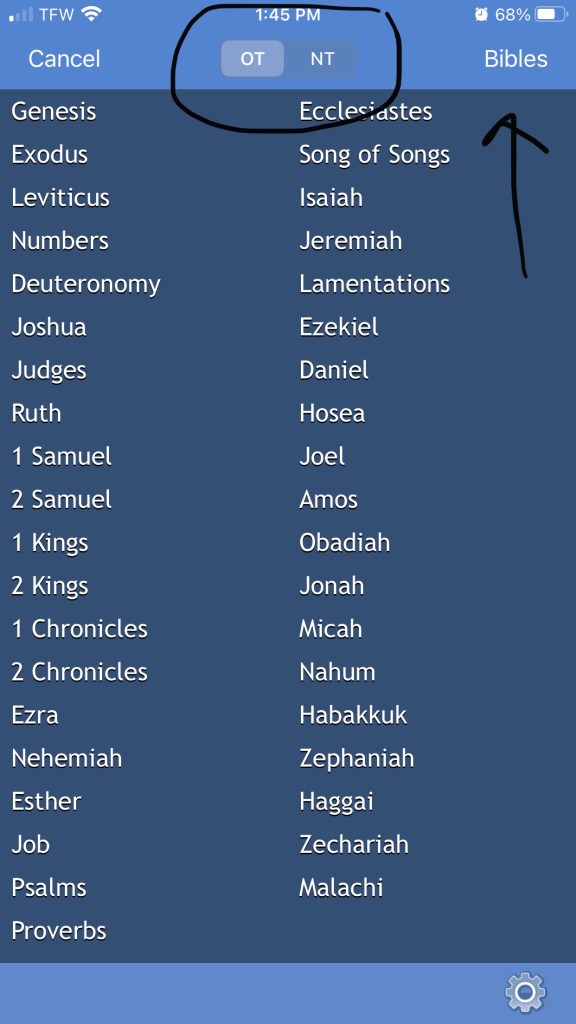
For the purposes of this blog, I’m going to the New Testament and choosing Matthew. You can see that the books are listed in order as they appear in the Bible. Click on a book to open it.

Next select the chapter you want. I’m using a verse from Chapter 4 as an example here.

Scroll down and click on the verse you want to study. I’m using verse 17.

After you click on the verse, you get the menu below. I’ll come back and talk about some other features here, but for now, we’re going to focus on studying the words of scripture in their original language, so click on “Interlinear/Concordance.”

Below, you’re looking at Matthew 4:17 in ESV. The Greek text is at the top followed by the ESV translation. I click the “Reverse Interlinear” button to put the English words on the left side of the screen. Just makes better sense to my eyes and brain.
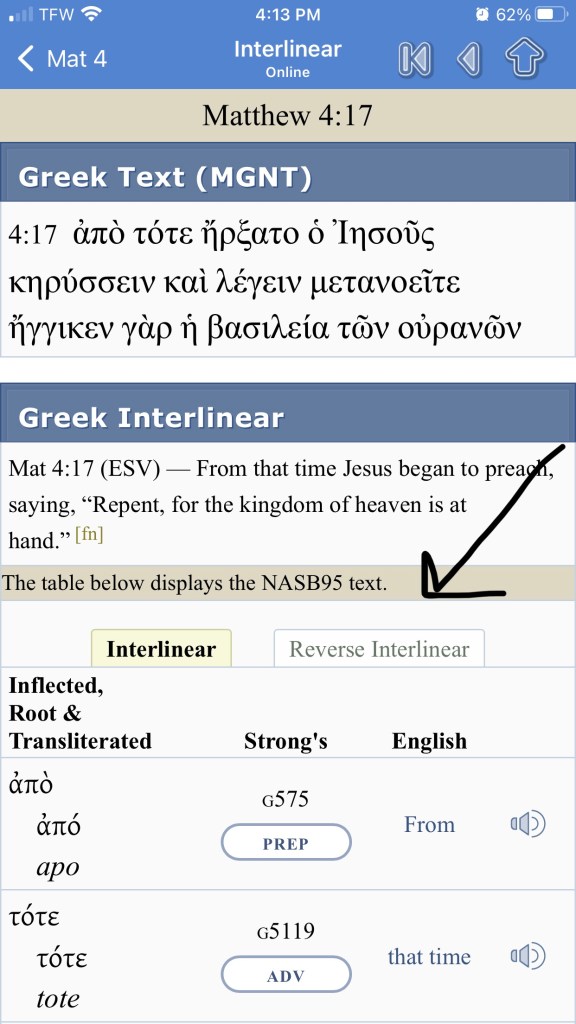
In this verse, let’s say we’re interested in the word “repent.” This is what Jesus preached once his ministry started; he began telling people to repent. So, I want to understand what he was saying. To me, “repent” means being sorry for what you did. But I want to see if there is something deeper here. It seems like an important thing if it was the message Jesus began his ministry with. So, scroll down and click on the word “repent” (somewhere near the English word itself. If you click on the oval in the middle of the screen, it’ll take you somewhere else).

On this screen, you see what the Greek word looks like and can click on the blue speaker icon to hear it pronounced. (I LOVE to do that). You can see the part of speech and any root words. (The blue words are hyperlinks you can click on to go to the entry for the root word).

But, what I’m mostly interested in here is the “Outline of Biblical Usage” section just over half way down the screen. You can see that the definition of repent, as it is used in this verse, goes far beyond simply being sorry for what you did. And THAT is exactly why I encourage you to learn to use BLB app or some other tool to study the words in their original language. Having this understanding of how the word “repent” was used gives me richer insight into what Jesus meant in his message when he began to tell people to repent. In the highlighted section, you’ll note that repentance is when a person turns “from sin to God” {emphasis mine}. Jesus commanded that people turn away from their past sins and turn toward God. Literally, look at God rather than the sinful world. Man! That’s so rich!
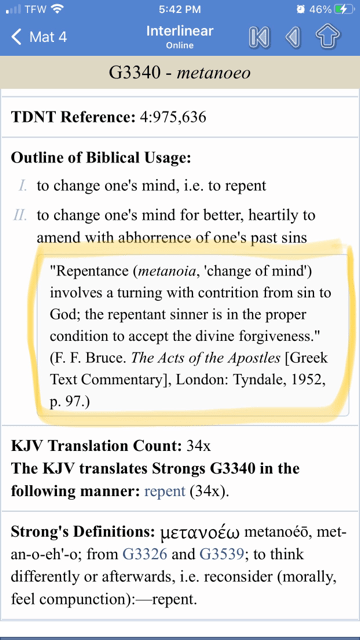
Once you have a better understanding of the general definition of the word, you can go another step deeper: scroll down, and look at the Thayer’s Greek Lexicon – circled below. This portion of the Interlinear/Concordance shows you exactly how the word was used in that specific verse – rather than a simple, dictionary-type definition. So, click on the link that says “Tap to view the entire entry” to open the full lexicon for the word.

Then, scroll to the bottom of this area where you see the heading “BLB Scripture Index of Thayer’s.” (I’ve also noticed that the lexicon isn’t exhaustive – it doesn’t list all the verses in the entire Bible that use the word in this specific way). However, many of the verses are hyperlinked here. So, when you find the verse you’re looking for, click on it, and it takes you to the place in the Greek Lexicon section where it shows how the word is used in the specific verse you’re studying. The highlighted portion below shows you exactly how the word “repent” was used in Matthew 4:17.
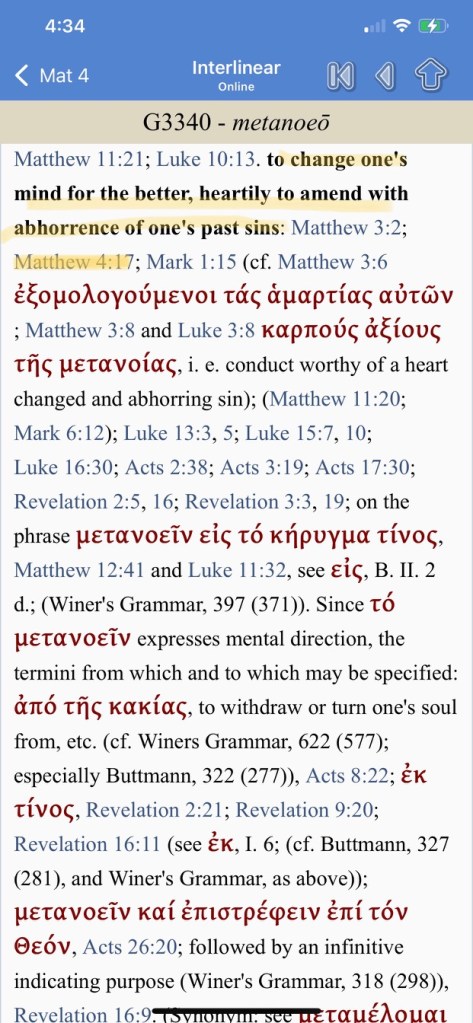
(There have been times I couldn’t find the exact verse in the lexicon. Not sure if I missed it or if it just wasn’t there. Either way, you have the basic definition(s) to go off of to get a good enough idea of what’s being said).

If you find that you love studying the Bible this way, I encourage you to try rewording the verses based on the original meanings you uncover. To do this, go through the verse, using BLB app and look up each word in the scripture or each key word or each word that was important to you. Once you had a solid understanding of the deeper meaning of the word, reword the verse using the information you found in your study. This has been a favorite activity of mine for Bible study.

*However, be sure you aren’t changing the meaning of the verse when you reword it. To be sure this doesn’t happen, pray through the word study with God, carefully look up each word, read the verse in a variety of translations, read surrounding verses to get context, and read commentary on the verse. Really dig deep into the verse before attempting to reword it. When you feel confident you understand it enough to work with it, then reword it.

*A fun hint I’ve picked up along the way is personalizing scripture. You can add your name into the scripture where a personal address might fit. Here’s an example using Matthew 4:17 – From that time Jesus began to preach, saying, “Repent, Heather, for the kingdom of heaven is at hand.” Add your name in the place of mine. You can do this with many, many verses, and it helps drive home the idea that God is speaking directly to you through His words in the Bible, and that His Word is still relevant today.

I’ve mentioned reading different versions of the Bible several times in this post, and BLB app makes it simple to do that. Without leaving the app, you can read most of the major translations of the Bible. When you’re inside the verse you’re studying, click “Bible Comparison” to switch between different translations.
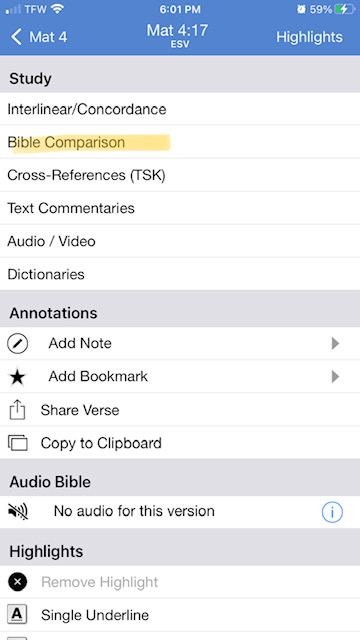
When you click “Bible Comparisons,” you start with the version you’re reading, but you can scroll down and read the verse in different translations. This has been such a helpful tool for me; I use it regularly to help me get a better understanding of the verse.

While you’re inside a specific verse, you can also click “Text Commentaries” (see highlighted below) and read commentaries on that specific verse, chapter, book, or the concept being discussed in that verse. A wealth of commentaries are loaded into the app.

I have come to enjoy David Guzik’s commentaries and will usually seek them out when I use this feature of BLB app.

Vine’s Expository Dictionary

Another app I use for studying original meanings of words in scripture is Vine’s Expository Dictionary app. It’s a more straight-forward and simpler to use than BLB. I use it when I already know the word I want to look up – I have a word in mind separate from a specific verse. (BLB is for studying specific verses then drilling down to individual words. Vine’s is for looking up the original language for a word you already know you want to study – not necessarily connected to a specific verse).

Below, the icon is circled, so you can find it in the App Store.

When you open the app, you have two choices for searching for the word – either type it in the search window at the top or click on the box with the corresponding letter of the alphabet and go from there.

I searched “righteous,” a word I often have to look up when I’m studying because I can’t get the meaning to stay in my brain 🙂 Once you find the word you want, click on it in the list.

Then, you can scroll through and read about all the varied meanings of the words in scripture. If you know a specific scripture, you can search the blue hyperlinks.

What helpful bible study hints have you picked up along the way? What tools help you most during your study time? Please share them here.
Remember God’s Goodness

There is no doubt that the past year has been one of the hardest and darkest in my life. Through prayer, Bible study, and journaling, I’ve uncovered some of the sources for my struggles: allowing Satan too much real estate in my mind and losing focus on God.

{But I may also be having some hormonal changes because of my age and the time I am in right now in life. That’s probably a whole other blog post on its own though…}

What is comes down to it, I forgot how much God loves me. I ignored the things He has done for me in the past.

They say “count your blessings” to help us remember to focus on what we have rather than fixating on what we don’t have. Because, if we fixate on what we aren’t, on the things we don’t have or can’t do, the enemy has fertile ground to plant seeds of distraction, discontentment, bitterness, jealousy…

I’m there – staring that dead in the face.

This summer, in an effort to renew my relationship with the Lord, I picked up where I left off in Psalms a while back and began reading a psalm a day.

{If you haven’t done this, I highly recommend it. The psalms are such a blessing. They allow us to see how God’s faithful children praise Him but also how the faithful ask for help and how the faithful confess fear and doubt. They allow us to see how the faithful admit when they can’t see what God is doing. When they need God. When they fail}.

The psalms I’ve read recently have helped me refocus on God’s trustworthiness.

For example, Psalm 91 reminded me that God is faithful. I can have confidence that He is with me. Protecting me. He has good things for me.

I’ve been fixating on the fact that I don’t have a job yet. I’ve been looking since February, and I’m discouraged. I’m sad, anxious, worried, and overwhelmed. All these feelings distracted me, and I completely took my eyes off of God’s goodness which He has shown me time and again.

When I read Psalm 91, God reminded me of a young married couple who was searching for their first home. (That would be my husband and me way back in 2007).

We were ready to move out of our apartment, so we got with a real estate agent and started looking at houses.

I don’t remember how long it took, but we must have looked at 50+ houses. I’m not exaggerating. I’m sure our agent was tired of us.

I specifically remember coming back to our apartment after a particularly unfruitful afternoon looking at a handful of houses and being overwhelmed with frustration because we didn’t see anything we liked.

I stood in the middle of the teeny living room in our tiny apartment and whined, “Why.doesn’t.God.want.me.to.have.a.house!” I may have even stomped my foot. I’m also pretty sure I cried about it.

{Crazy that I blamed God when I wasn’t even walking with Him at the time. }

What struck me recently when I read Psalm 91 is how wonderful our first house was once we found it. It wasn’t our first choice. It wasn’t our dream home. It wasn’t up-to-date or turn-key. We did a TON of work to it in the 7 years we lived there. But we loved.that.house and made beautiful memories there.

For one thing, the neighborhood itself was perfect. I enjoyed walking in it when my babies were in strollers and later when they were toddling or riding their tricycles.

One of our next-door-neighbors was a former pastor from Olivet, the first pastor I remember from when I was a little girl. It was cool to see him and his wife again.

Today, in 2023, nearly 16 years after we bought our first house, I have enough critical distance to see that it was God’s plan for us to be in that house during that time. When I stood in our apartment that day in 2007 and whined about God not “wanting” me to have a house, I couldn’t see it. But 16 years and two houses later, I can see God’s providence in our lives. Remembering that experience confirms for me that I can trust God with whatever issues I have going on now.

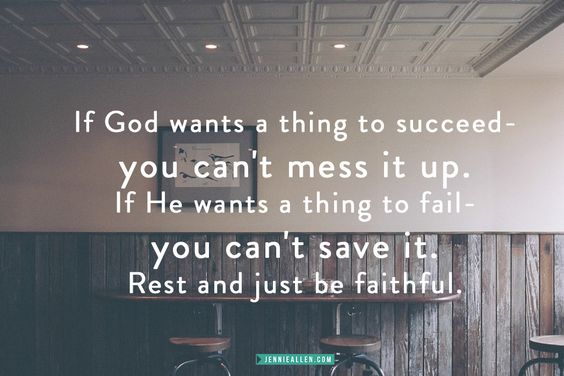
My point is this: I need to wait patiently and trust God because His plans for me are good. He will prosper me and not forsake me. He’s shown me His faithfulness on more occasions than I deserve. I may not find my “dream job” yet, but everything will work out for the best anyway. I have no doubt that I’ll be right where God meant for me to be in the end.

Psalm 91:2 “…my God, in whom I trust…”

Patiently wait and trust God.

His plans are good.

How to Be a Godly Woman – Esther’s Example

I want to be a godly woman, a woman whose life has been visibly impacted by the gospel message. This type of life brings glory to God, and that is a Christian’s purpose.

I want that for your life as well.

Let’s be women whose lives please God. Let’s be women who respond with humble obedience to the Good News that Jesus gave His life for our salvation…

Ok, whoa. Time out. Let’s stop here. This sounds great and all, but what does it mean? HOW do we live godly lives? It’s great to want to, but how do we live it out?

We’ll look to God’s word for examples.  Queen Esther, a Jew who became a queen of Persia, showed herself to be a godly woman many times throughout her story in the book of Esther in the Old Testament.

Image Credit: KnowingJesus.com

God gifted Esther with a personality and beauty that won her favor with many people she met in her life including the King of Persia, who “loved her more than all the women, and she won grace and favor in his sight…so that he set the royal crown on her head and made her queen…” (excerpts from Esther 2:17, ESV)

Even more impressive than being able to make the king fall in love with her, was Esther’s faith in God. Her faith propelled her to act on behalf of her people when her uncle Mordecai discovered a plot against them. When Mordecai uncovered the plot, he shared that knowledge with Esther, asking her to go to the king and beg him to help the Jews.

Truthfully, Esther was fearful at first.  She knew that taking matters into her own hands and speaking to the king before he called for her company would mean certain death.  (There was a law that said no one, not even the king’s wives, could go to the king unless he summonsed them).  She initially told her uncle she couldn’t help.  However, he reminded her to trust in God’s providential timing and to fulfill her personal calling.  In Esther 4:14b, Mordecai points out to Esther, although indirectly, that God made wife to the king of Persia during a very specific time and for a definite reason – so He could save His children, the Jews, through her.

Image Credit: faithit.com

Esther showed herself to be a godly woman in her response to the request from her uncle.  She chose to trust God’s will for her life and to take courage and do what was right for God’s people.  She said, “Go, gather all the Jews to be found in Susa, and hold a fast on my behalf, and do not eat and drink for three days, nights or day.  I and my young women will also fast as you do.  Then, I will go to the king, though it is against the law, and if I perish, I perish.”

Basically, she said, “Bring it on. I trust God’s will for my life and His timing.  I choose to bloom where I’m planted.”

But seriously, this is what we learn from Esther about how to be godly women: godly women submit to God’s will for their lives, like Jesus’ mother Mary didThey also trust God’s providence and His timing, and they are willing to work for God’s kingdom in their places of influence.

Godly women yield to what God has planned for us. We say yes to where He leads us. We allow Him to carry out His will through our lives. We are productive for the Kingdom in the places God puts us. Submitting to God involves trust in who God is. It involves confidence that He is sovereign and good and just. Again, this sounds good, but how exactly do we get to this point? Pray. Ask God to help us do this. Ask God to have his way in our lives. (Then be ready to yield when He directs you). Listen. How does God respond to your request? Where does He say to go? What does He say to do? Read. Go to scripture and read about other godly women for more examples of holy living. Talk. Seek out women who are leading godly lives. Consider why you think they’re godly? What about their lives leads you to believe they are living a life pleasing to God? What behaviors do they model? Ask them to describe times in their lives when God has required them to submit. Find out what obedience to God looks like and feels like in their experiences. Respond.  Do what God directs you to do.  Live the way He has told you to live.  Turn away from the things He tells you to turn away from.  Be productive for the Kingdom of God in your places of influence. This isn’t something that will happen in a day or two. This will take repeated time alone with God in prayer and in reading His word. This will mean praying daily for God to help you submit to His will…even after you think you’ve submitted, pray each day that God will help you submit to Him that particular day. I passionately encourage you to pursue a deeper relationship with God in this way.  Submit to His will for your life.  Adorn the gospel with your behavior.  Let the world see how your faith has impacted your life.  Be joyful and act on what is right in the places He has put you. Guided Prayer: Father, Thank you for sending your Son to die for me. Thank you for making a way for me to have eternal life with you. Thank you for pursuing me and for bringing me to yourself. I want people to see that your sacrifice has impacted my life. I want people to see that you have changed me. I am your servant girl, Lord. I believe that you have me in this place at this time for a purpose.  You created me for this.  You have shown me that I can trust you. I want to submit my life to you, Lord. I don’t know what that looks like, but you do. I don’t know how to do it, but you do. Help me to do it, Lord. Help me to yield my plans and my agenda and my schedule and my to-do list to you. Make me humbly obedient. Make me your servant girl every day of my life. Amen


Thoughts – Does it say that in the Bible?  See – https://www.thegospelcoalition.org/article/biblical-say-bloom-youre-planted/

What Happened the Week Before Jesus Died?

The triumphal entry. The Last Supper. The Garden of Gethsemane. The illegal trial. Jesus’ crucifixion and burial.

Image Credit: bible.com

It’s likely you’re familiar with the events. You’ve been to church or Sunday school or Bible school or youth camp. You’ve heard the stories. But have you ever explored them on your own? Would you like to get a fuller picture of what happened to Jesus in the week before He died and after His death and resurrection?

We celebrate Easter in 4 weeks (Sunday, April 4, 2021) , so let’s start now to prepare our hearts.

Over the next 4 weeks, I’ll post guided readings from the gospels – Matthew, Mark, Luke, and John – as well as questions to consider that will help you survey the events of Jesus’ Passion week – the week before he was crucified – through His resurrection and ascension. We’ll get a fuller perspective of the events of his last days in the flesh by reading accounts of the events as described in three and sometimes all 4 gospels. This allows us to do a side-by-side comparison and to contrast the information – not to find contradictions, but to give us a more well-rounded look at what took place.

Image Credit: biblegateway.com

What to do before and during the study:

  • Pray to prepare your heart. Ask God to show you new information, something you haven’t seen before in stories that are well-known.
  • Read the listed verses. (Reread if you have time). If a verse or group of verses stands out to you, make note in your Bible or your journal.
  • Study words in the original Greek that catch your attention or that you’d like to understand better using apps like Blue Letter Bible.
  • Follow the cross references listed in your Bible.
  • Read commentary on the verses.
  • Pray some more.
  • Journal about what you’re reading and learning. About what stood out that you hadn’t noticed before. Note any questions you still have.
  • If you’d like to engage with me or other readers, comment on the blog or on Facebook when I publish the posts.
  • Reach out to me personally through the blog or through Facebook if you’d like to talk about anything.

As you read the gospels remember:

  • They highlight major events in Jesus’ life as he carried out his Father’s will.
  • They are historical writings – told by eye witnesses or collected from eye witnesses.
  • Most are organized topically rather than chronologically. (This is the way many people talked and wrote at the time. They grouped events together that were similar in topic – not necessarily based on the order in which they happened. This is why events aren’t always in the same order in the different books).

{The following are short introductions of each of the four gospels and their authors. Information is taken from the English Standard Version Study Bible and the MacArthur Study Bible}.

Matthew

Image Credit: Steppesoffaith.com
  • one of Jesus’ 12 disciples – an eye-witness to Jesus life. Matthew saw first-hand the things he wrote about because he was there – talking with Jesus, eating with Jesus, walking with Jesus, healing with Jesus, learning from Jesus.
  • a former tax collector – a Jew by birth – would have been familiar with Jewish law, the books we call the Old Testament, etc.
  • also called Levi
  • gospel written between late 50’s and early 60’s AD (after Jesus died)
  • Matthew’s purpose in writing down his gospel was to persuade Jews that Jesus was the Messiah.
  • Events are organized topically. Matthew’s gospel is known for not having events in the same order as the other gospels.
  • Although the exact way Matthew died is unknown, it is accepted that he was martyred (died for preaching and teaching the gospel). Many accounts say he was in Ethiopia at the time of his death.

Mark

Image Credit: flickr.com
  • not an eye-witness to Jesus’ life, but a close friend and companion to Peter – one of Jesus’ disciples. Mark was Peter’s writer – he wrote down many of the letters and things that Peter dictated to him. He is mentioned in Acts and other New Testament books.
  • also called John-Mark
  • He wrote his gospel mostly for Gentiles emphasizing discipleship, having a relationship with Christ, trusting God, and letting Jesus be Lord and Savior of believers’ lives.
  • gospel written in mid-50’s AD – likely in Rome while working with Peter

Luke

Image Credit: pinimg.com
  • a Gentile who converted to Christianity (the only Gentile to write any book of the Bible).
  • originally a physician/doctor from Antioch
  • a close friend of Paul’s
  • His gospel isn’t a first-hand account as he was not an eye-witness to the events he wrote about. However, he was known to have researched by talking to people who had been with Jesus and had seen the things Jesus did during his ministry.
  • also wrote the book of Acts
  • gospel written in 60 of 61 AD in Rome at the same time as Acts was written.
  • Luke wrote his gospel for Gentiles. He wanted people to know that the Good News was for everyone.
  • {interesting side note – Luke emphasized the central role of women in Christ’s ministry – he talked at length about the women who supported Jesus ministry with money or other forms of assistance}

John

Image Credit: bible.com
  • one of Jesus’ 12 disciples (His gospel is eye-witness testimony.)
  • the brother of James – also a disciple. They were known as the sons of Zebedee.
  • known as “the beloved” and “the disciple who Jesus loved.” {side note – From the cross, Jesus requested his mother Mary be cared for by John}.
  • time frame of writing is hard to pin down – some scholars say between 70 and 100 AD. Others say between 80 and 90 AD
  • gospel written well after the other 3 – Matthew, Mark, and Luke, known as the Synoptic Gospels
  • John’s gospel supplemented and complimented the other 3 gospels. His account of the events added a unique perspective and fill in other details that aren’t found in the synoptic gospels.
  • Most scholars believe John was the only disciple to die of old age although he did spend time exiled on the island of Patmos for preaching the gospel.
Image Credit: zazzle.com

I’ll send out the first official readings tomorrow evening, but I wanted to share with you an optional reading to provide some more context for the next 4 weeks of study.

John 11 tells the story of Jesus raising his friend Lazarus from the dead. The chapter ends with the Pharisees plotting to kill Jesus as the Passover week is about to begin.

John provides the only account of this event.

Why We Should Let Our Children Fail {Sometimes}

I’m that parent. I don’t protect my children from every hardship. Struggling builds character. (Sounds like something my parents probably told me when I was younger. I imagine it infuriated me at the time time, but now I realize they were right…like they were about most of the stuff they told me).

Working through hardships helps children learn life skills such as endurance, perseverance (or stick-to-it-iveness as we call it where I’m from), stamina, and self-regulation. They learn about themselves: their strengths and weaknesses, what they can handle on their own, and when they need to ask for help.

These are all good things kids need to learn through the experience of living life as they figure out something hard or work through a challenge.

Of course, parents should support and encourage, but we don’t need to jump in and fix it or rescue them every time they hit a difficult place.

We can model how to work through the difficulty. We can support and encourage them with our words. We can help them talk through mistakes to figure out where they went wrong. We can assist them in developing strategies or alternatives for avoiding the same mistake in the future.

Ethan doing his schoolwork virtually. He’s sitting on the floor on top of the pillow from Zoe’s kennel and an almost-flat beanbag. He’s trying to type with his Chromebook in his lap. But, whatever works, right? I guess sitting at the table was getting boring.

Here’s a conversation I had with Ethan yesterday:

Me – Well, that assignment took 2 hours. What happened?

E – I had to watch the video over a couple of times.

Me – Why?

E – I watched the video, but I didn’t know what the teacher wanted me to do afterwards. When I went read the assignment and what questions I was supposed to answer, I didn’t know any of the answers from the video, so I had to watch it again.

Me – What could you do differently next time so it doesn’t take that long?

E – Read the whole assignment first, write down the questions I need to answer from the video, take notes while I watch the video?

This is something his dad and I and his teachers have told him about doing assignments where you have to watch videos and answer questions with information from the videos. Many times when he does an assignment like that he doesn’t follow the advice he’s been given, so an assignment that could probably be completed in under an hour consumes more time than it should.

Don’t get me wrong. I’m not awesome at this “natural consequences parenting”. Sometimes I panic when I foresee the outcome of one of their decisions. Occasionally, I feel bad when they struggle with a task. I want to offer a bail-out from time to time.

Especially when it comes to this virtual-learning-during-a-pandemic stuff. Recently, I have described our journey in virtual learning as “excruciating,” and I have begged for anybody and everybody to help me alleviate this pain. (Facebook friends may remember my desperate plea just last week when I was looking for suggestions for ways to help him stay focused while he does his school work virtually from home). In particular, virtual learning is a learning experience for me, too, but we keep at it every day.

What I do know is that I can’t rescue either of my kids from all their messes for their entire lives, so I probably shouldn’t get them used to it. Yes, they will need help negotiating lots of situations. Some will require a bail-out from mama or daddy. Other times, it might be best to let them stumble and maybe even fall on their faces (with me within arms reach of course – just in case) so they can figure out how to get themselves up again. Failure can be good for a person 😉

PS. After I wrote this today, I discovered that Ethan had gone through yet another video-watching assignment without following the advice for completing the assignment that I know that he knows (see our conversation above). When I asked him why it took him so long to do the assignment, he grinned at me…

How to Survive the New Normal

The New Normal.  That’s what we’re calling what’s happening right now.

It started March 11, the last day of school in our district.  It became “real” March 31, the first day the stay-at-home order was in effect in our state.

Everyone talks about the new normal.  We know what it means: the way we’re living during the pandemic with churches, schools, libraries, restaurants, and parks closed.  With people wearing masks and plastic gloves to the grocery store.  With people having virtual visits with their doctors.  With people working from home and having staff meetings on Zoom.

What’s your new normal look like?

For me, it’s been about finding balance.  I can’t lean too far to the left or to the right or the boat will flip over.  I gotta keep it in the center.

At our house, our attempts at finding balance during the new normal have looked like this:

1. We try to keep our lives and our schedule as close to what they used to be as possible.

2.  We try to embrace the changes we’ve experienced – things being added to and taken from our lives.

You could try to keep your life and schedule as close to the same by…

  • waking up in the morning around the same time you used to; going to bed at night around the same time.
  • washing your face every morning and every afternoon; taking a shower every day.
  • eating like you normally eat; don’t go crazy with a lot of junk food and sweets.
  • having meals at normal times.
  • emphasizing more time playing outside, building with LEGO (my kids love LEGO), drawing, reading, or writing, and less time on screens or social media.

You could embrace new things and changes by…

  • taking a walk, riding bikes, playing a board or card game, or watching movies together everyday (hey, we have a lot more free time now, right?)
  • eating a picnic lunch outside.
  • wearing pajamas all day.
  • tackling that home improvement project you’ve been putting off.

Like many people, I’ve chosen to keep some parts of my old, daily routine the same in the new normal even though I don’t have to do so.  I change out of my pajamas and wash my face in the morning and at night.  Continuing to do these things makes me feel better.

I have a friend who puts on her make-up every day although she isn’t leaving the house for work anymore.

Some people still drive to Starbucks for their morning coffee even though they no longer have a commute to work.

A few friends still wake up at their regular time for Bible study or their morning job even though they could do it later in the day since they’re currently at home with their children.

Honestly, the new normal isn’t like the life we were used to.  Lots of plans have changed.  We can’t do a lot of things we used to be able to do.  But I think we can figure our how to keep our wits about us and push through until this thing is over.  And I have faith that it will be over.


John16_33OvercomeTheWorld

Image Credit: PhDmind Blog


The Cliche Question

Why do bad things happen to good people?

A friend who desperately wanted to have a second child finally got pregnant after about three years.  When she and her husband went to the 18 week ultrasound, eager to learn the sex of the baby, there was no heartbeat.  She had to go to the hospital later that week to deliver a little boy who they’d never take home.  They named him Benjamin, held him a few minutes, and that was that.

I didn’t know how to talk to her about it.  We took them dinner a week or so later, and they asked us to stay and eat with them.  It was awkward, to say the least.

What do you say to someone who’s just had to give up their heart’s desire?

She told me, “I’ve been praying for God to use me.  I can’t get mad at Him when He does what I’ve been praying for him to do.”

That’s when I realized why this was happening to her.  It happened so she and her family could bring glory to God through their response.

We search and search for answers when bad things happen.  Why did this happen?  Why me?  Why us?  Did I do something wrong?  Is God mad at me?

But the answer is simple: all things – even the tough, the crappy, the hard, the ugly, the terrible – are an opportunity for us to glorify God.

{ This post was written a part of Five Minute Friday’s Weekly Blog Link Up – https://fiveminutefriday.com/linkup/ }


The Quiet Advent Calendar (Repost)

It’s December 1.  Did you start your Quiet Advent Calendar?  (I’m a little old-fashioned, so I printed out a hard copy of mine 🙂 ) This is a repost of last week’s post, but I don’t want you to miss it.  Please join me:

The frenzy is already building.  Can you feel it?!  The frenzy that is the Christmas season – only 31 more shopping days to go!  Who’s left on my gift list?  What am I going to bake to take to my in-laws’ house on Christmas Eve?  I didn’t even start decorating yet!!!

Oh my goodness!  No wonder we rarely enjoy the season anymore.  It’s too crazy busy.

Let’s take back the holiday season this year.  Let’s focus on the real reason we celebrate – the birth of our Savior, Jesus Christ.  Let’s prepare our hearts for the Advent season.

I’d like to invite you to “The Quiet Advent Calendar” from my friend, Julianne Gilchrist.  Join me in 24 days of delighting in this season of Advent.  I’m excited for this Advent Calendar because, as I’ve gotten to know Julianne over the past 6 months, I’ve discovered that she’s all about slowing down, breathing in, and just being with God.  Her concern is helping people learn to hear God’s voice above the hum-drum of life.  And I can see her desire for sacred space built into “The Quiet Advent Calendar.”

If you plan to join, let me know, and we can walk through it together.  Just click on “The Quiet Advent Calendar”, fill in your name and email address, click Send Me The Quiet Advent Calendar, and settle in and get ready.

I can’t wait to get started.

A Love Letter from God (Repost)

Author’s Note: Ethan and Emery are in school, and I have been at my new job for a few weeks now (will blog about that soon since I addressed it in an earlier post). So, I am taking a short break from writing new posts this month so I can focus on time with the kids and getting used to the new job.  In the meantime, I am reposting pieces of my testimony that were published when I started the blog in October 2017).  This is the last post in this series, and new posts will start next week.

Why?  That’s the question I asked myself over and over when I was trying to “get right” with the Lord.  Why did this happen to me?  I was raised in church!  I was saved when I was young!  How did someone like me go so far as to not even believe in Jesus anymore?!  Why did I have to go through this?

The short answer is – it happened to me so I could tell you.

God gets glory through the lives of His children – when we surrender to Him.  When we live for Him.  When we obey Him even when what He’s asking is scary.

This happened to me – this time spent away from God and then coming back to Him again – so I could write to you and tell you.  This happened so you could look at my life and see who I have been and what I have done and where I have gone…and see Jesus.

This happened to me because it was the only way I was going to give Him control over my life.  He knew me and what it was going to take for me to honestly come to Him…not just go to church because that’s how I was raised.  He wanted me, but I had to want Him.  He wanted a relationship, not the religious person I was when I was younger.

I believed with my head, but He wanted my heart.  My heart was more difficult to convict, but I am grateful for the journey.  I wouldn’t have the relationship with Him I have now if it weren’t for this journey.  I’d still be trudging along in legalism and good-girl church stuff.

I wouldn’t have any idea how to talk with Him or listen to Him, and I certainly wouldn’t be telling you about Him.

But, here we are.

(If you just found this blog, please go back and start with the first post, June Cleaver? Who Me?, so all this makes sense).

Here’s some of what I’ve learned and what God wants me to share with you.  (I have included some scripture references; however, the list isn’t exhaustive.  It may not even be the best and most relevant reference, just one that I found while researching).

{WARNING: these may sound like the cliches you always hear Christians say.  They did to me at one time, but they are real to me now that I have truly experienced Him}.

  • The presence of the Holy Spirit – the one God sends to live inside you when you believe in Him – will change you.  You will not be the same.  You cannot think the same or behave the same as you did before.
  • God is sovereign (Psalm 103:19, Psalm 115: 3, Romans 8:28).  He wants us to surrender our lives to His sovereignty – TOTALLY.  Simply acknowledging that He is real is not enough (James 2:19).
  • Take thoughts captive (2 Corinthians 10:5) when they go against biblical truths.  Guard your heart (Proverbs 4:23) against lies the world will tell you.  Go to God whenyour thoughts are leading you astray.  Go to God when you find that your heart is turning away from Him.
  • God wants us to trust our lives to Him.  He was us to be obedient and follow where He leads (Psalm 37:5, Proverbs 3:5-6).

  • Pray (Philippians 4:6).  Talk to Him.  Read your Bible (Philippians 4:6, 2 Timothy 3:16-17).
  • Write what you’ve learned.  Write what you feel.  Write questions you have.  This is journaling, and this is a way to have a conversation with God.
  • HE IS ALWAYS RIGHT THERE (Hebrews 13:5). He doesn’t move.  He doesn’t go away.  You may, but He doesn’t (Psalm 16:8).  He is waiting right there for you to decide that you want Him.  He wants you, and He wants you to want Him.
  • God speaks to me.  God will speak to you.  It may not be an audible voice you can actually hear with your ears, but once you learn to hear and understand His voice and how He speaks to you, you begin to realize that He speaks to you all the time in many different ways (John 10:27).

  • God is persistent.  He has a plan and a purpose for your life.  He will continue to woo you in the direction He wants you to go (Proverbs 19:21).
  • God doesn’t need us to fix ourselves before we come to Him.  We can’t anyway.  We simply go to Him, give ourselves to Him, and then He does the fixing.  If you are waiting until you’re “better” or “right” or “good” to go to Him, please stop right now.  You’re wasting precious time.  Just tell Him you want Him to take over your life.  Tell Him you believe in Him and want Him as your Savior.  He does the rest.
  • Obey – immediately! (James 4:17)

  • Be still and be quiet (Psalm 46:10, Exodus 14:14).  God doesn’t scream and shout and stomp His feet.  If you aren’t still and quiet, you’ll miss what He has to say.
  • Turn towards God.  That is what He wants – your permission to take control of your life.

My journey wasn’t in vain.  I know this.  God has shown me.  It happened for me – to save me, and it happened for you – to save you.  You need to know that God is right there.  You need to know that whatever you did wasn’t so bad that He doesn’t want you.  You need to know that you haven’t gotten too far away from Him.  HE’S RIGHT THERE WITH YOU!  HE LOVES YOU. HE WANTS YOU.

Talk to Him.  Read about Him.  Write to Him.  Ask trusted Christians about Him.

He’s got a journey to take you on, too.

I was the Prodigal (Repost)

Author’s Note: Ethan and Emery are in school, and I have been at my new job for a few weeks now (will blog about that soon since I addressed it in an earlier post). So, I am taking a short break from writing new posts this month so I can focus on time with the kids and getting used to the new job.  In the meantime, I am reposting pieces of my testimony that were published when I started the blog in October 2017). 

It was a gradual thing: me turning my back on God and deciding Jesus never existed.  It was gradual, but it eventually held fast.  My heart became stone.

Just as gradual was me turning back TO God.

He had been working on me persistently since about 2005, and He really stepped it up when He called me to leave my full-time job to stay at home with our son.  Through a series of events, He kept wooing me closer – slowly but steadily.  He had me in a group of Christian moms who met in a MOPS group sponsored by our church.

I was searching – this time for Jesus.  I really wanted Him to be real to me again.  When I read things in the Bible that He’d done, I wanted to KNOW for sure that those things had actually happened.

I wanted to KNOW that His feet had taken Him to sit by the well where He talked with the woman from Samaria (John 4:4-26).

woman at the well.jpg

Photo Credit: Pinterest

I wanted to BELIEVE that He actually wore the cloak that the woman in the crowd touched.  She’d been afflicted for nearly 12 years and had found no relief.  However, she heard that Jesus was coming and believed that just touching His clothes would heal her (Luke 8:43-48).

woman who touched Jesus' cloak.jpg

Photo Credit: Pinterest

After about a year, the MOPS group dissolved into a Women’s Bible study.  I moved on to that with some of the mom-friends I had from MOPS.  I was very excited!  I was ready to be pushed and challenged and really dig into the Word.  It was time!  God was stirring. He had been working on my stone heart; it was softer now and ready to be fed.

I dove head-first into the first Bible study, Living Your Life as a Beautiful Offering, by Angela Thomas.  In this study, Thomas uses the Sermon on the Mount to show how to give our lives as an offering to God.

I prayed.  I read the study and my Bible.  I wrote in my journal – things I felt, prayers to God, and what I learned from reading the scripture.

God began to speak to me – through the study and through sermons at church.  I had never been convicted by a sermon in my life!

Our preacher, Mike Whitson, talked one Sunday about how a Christian should show God’s love.  We should love other people simply because they are God’s child, not because they are lovable.  I realized I didn’t love people unless I wanted to.  During the invitation, the preacher called for people to come to the altar, and I practically RAN down there!  It was one of the few times in my life that I have voluntarily gone to the altar.  I begged God to help me love people because I didn’t.  I asked Him to break my heart and make me love people the way He did.

About the same time, Preacher Mike gave another sermon about the Christian life producing fruit because of the Christian’s relationship with God.  I didn’t have anything like that in my life.  I could say I was saved when I was 12, but now I was in my mid-30’s and had nothing to show for it.

Those two sermons convicted me.  I prayed and prayed and prayed some more.  I asked God to break me.  I asked Him to help me to love people like He did.  I begged Him to help me believe in His Son again.

And, all of a sudden, He DID!  Jesus was there, and He was REAL!  The process God used to get me to that point was gradual, but He was working on me and softening my heart. When I finally realized it, it seemed like everything was just…“POOF”…fixed…after praying and begging and reading and journaling.

slow are the steps.jpg

Photo Credit:Pinterest

HE WAS REAL AGAIN!

When I read things in the Bible that He’d done and said I saw them and heard them and believed them.

The Angela Thomas study showed me that I did a crucial thing – I turned back towards Jesus.  That’s all He wanted.  He wanted me to ask.  He waited for me to give Him permission to take over my life and heart.  I didn’t need to do anything to fix myself or make myself believe in Jesus again…except turn my face back towards Him.  He did the rest.

Thomas used the story of the prodigal son to illustrate this concept.  She described how the prodigal realized the error of his ways and set out for home to ask his father’s forgiveness and to ask him for a job.  The story says, however, that when the father saw the son, way off in the distance, coming back toward home, the father RAN to meet the son.  The father was so excited that his wayward child was coming home that he didn’t wait on his child to get to him…he RAN out to meet his son.

prodigal scripture.jpg

Photo Credit: Pinterest

Thomas explained that this is how it is with God – you simply have to turn towards Him and He will run to you.  This is exactly what happened to me.  He saw me turn towards Him.  He knew my heart, that I wanted Him, and HE RAN TO ME!

prodigal son grace.jpg

Photo Credit: Pinterest

Praise the Lord!

He healed my damaged mind.

He softened my heart to allow Himself back in…and I believe!

I KNOW!

Hallelujah!

point of the prodigal son.jpg

Photo Credit: Pinterest